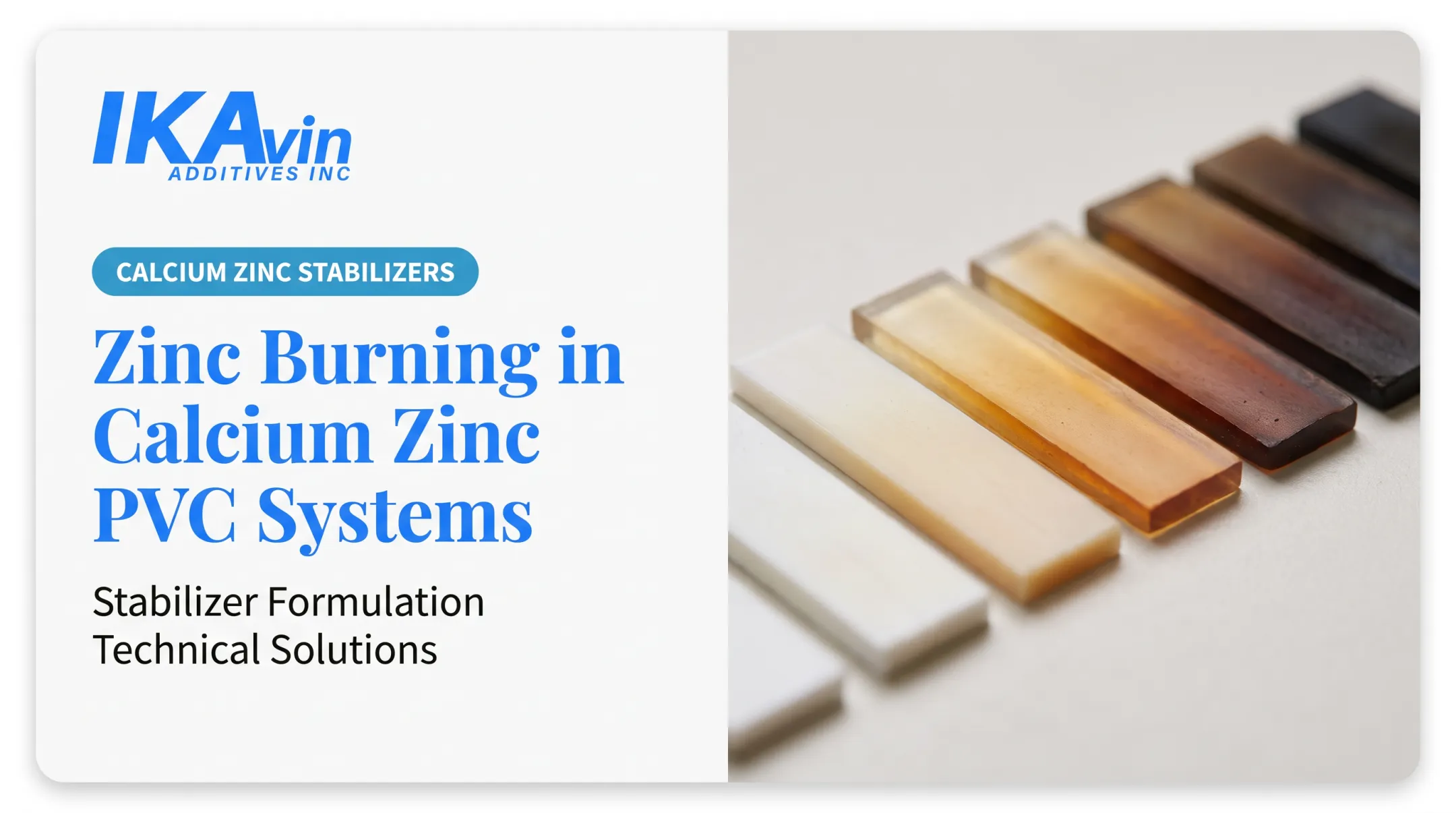
It's tempting to treat early color as a cosmetic nuisance. It isn't. Early color is a signal that something in the formulation or process has shifted, whether that's incomplete stabilization, excessive heat history, poor fusion, contamination, or a stabilizer package that's mismatched to the application. This article walks through the root causes and the practical checks across formulation, lubrication, processing, equipment, and quality control.
Key Takeaways
- Early color usually comes from interacting variables, not one failed additive.
- Investigate stabilizer balance, lubricants, fusion, residence time, shear, and contamination together.
- Raising stabilizer dosage without a diagnosis can hurt fusion, cost, or finished-product performance.
- Controlled trials, objective color data, and application-specific one-packs deliver more consistent early color.
Common Causes of Early Color in Ca-Based PVC Systems
Early color is different from long-term UV weathering, in-service oxidation, surface contamination, or discoloration that only shows up after extended heat aging. It appears during or immediately after processing, which points investigators toward the formulation and the machine, not the end-use environment.
Calcium-based systems are particularly sensitive to balance. The interplay between calcium components, zinc or other co-stabilizing components where present, co-stabilizers, lubricants, processing aids, pigments, fillers, and the resin itself determines how the compound behaves in the first few minutes on the line.
Stabilizer-System Imbalance
A Ca/Zn-carboxylate study found that formulations at 3 and 5 phr improved thermal stability, yet none of the high-Ca/Zn formulas tested achieved good initial whiteness, a finding reported in a palm-oil-derived carboxylate study. Stability over time and attractive startup color are not the same outcome.
Judge a Ca-based system as a complete package, not by calcium content or total dosage alone. Common triggers for a sudden imbalance include:
- A new resin lot
- Increased filler loading
- A different pigment grade
- Added recycled content
- A lubricant change
- Switching from a one-pack to separately dosed ingredients
Lubrication and Fusion Mismatch
Lubrication and fusion are tightly linked, and getting one wrong usually shows up as the other. Excessive external lubrication delays fusion. Insufficient or poorly balanced lubrication increases friction, shear heating, and localized degradation.
Either direction produces visible symptoms: uneven color, low gloss, rough surfaces, streaking, or color variation across the profile, pipe, sheet, or molded part. Before touching stabilizer dosage, compare fusion behavior and torque or pressure trends between a good batch and a suspect one.
A torque-rheometer study on rigid PVC formulations treated calcium stearate and paraffin wax as direct variables affecting fusion time, torque, and temperature. That approach is worth replicating internally with your own one-pack and lubricant combination.
Excessive Heat History, Shear, or Residence Time
Barrel, die, mixer, or mold temperatures; screw speed; throughput; pressure; residence time; start-up delays; and material trapped in dead zones all contribute to dehydrochlorination and color shift.
Here's the catch: actual melt temperature can run well above the displayed set point because shear and friction add heat the controller never sees. As one extrusion technical explainer puts it, barrel settings alone don't establish true melt temperature. Shear contributes substantially to the heat the compound actually experiences.
A quick diagnostic split:
- Color worsens with slower throughput or after a stoppage → points to residence time and heat history.
- Color tracks with a specific temperature or screw-speed change → points to a processing-window or formulation sensitivity.

Raw-Material Variation, Dispersion, and Contamination
Inconsistent resin, filler moisture or surface treatment, poor pigment dispersion, recycled content, foreign particles, and degraded compound sitting in dead spots can all cause early color independent of the stabilizer package.
Poor dispersion creates local pockets where stabilizer or pigment is effectively absent, even though the average formulation looks correct on paper. Degraded material lodged in a dead zone can release as yellow streaks, dark specks, or unexplained batch-to-batch drift.
Industry troubleshooting on streaks and black specs identifies retained degraded resin, feed-system contamination, and regrind as recurring culprits worth ruling out before changing the stabilizer.
Before attributing the problem solely to the Ca-based system, trace raw-material lots and run side-by-side testing of retained samples against finished product.
What Happens If Early Color Is Ignored
Letting early color slide doesn't just cost you appearance. It compounds into rejected production, customer complaints, rework, and unstable appearance across runs. Troubleshooting on the fly also cuts output, and teams under pressure often reach for an additive change or unplanned downtime instead of a diagnosis.
There's a deeper risk too. Early discoloration can be the first visible sign of broader thermal degradation. Later effects include:
- Reduced surface quality
- Weaker mechanical properties
- Off-odor
- Inconsistent fusion
- Shortened long-term durability
Warning Signs of Early Color Drift
Catching drift before it affects a full run saves material and time. Watch for:
- Color changes after start-up, stoppage, or slow running — degraded material or excessive heat history building up in the melt
- Yellow streaks, dark specks, dull patches, or gloss variation across the flow direction — dispersion issues, contamination, or localized overheating
- Color shifting when screw speed, throughput, filler loading, lubricant level, or temperature changes — narrow processing window or formulation imbalance that needs wider margins
How to Prevent Early Color
Prevention comes down to combining application-specific formulation design, raw-material consistency, processing discipline, equipment cleanliness, and objective color testing. Any one of these in isolation rarely fixes a recurring problem.
Select and Validate the Complete Stabilizer Package
Match the Ca-based one-pack to the resin, the application (rigid or flexible), the filler and pigment system, the processing method, output targets, and required color performance — both initial and long-term.
Review the full formulation balance together:
- Stabilizer components and co-stabilizers
- Lubricants and processing aids
- Pigments, fillers, and plasticizers where relevant
- Any recycled content
Compare candidate formulations in controlled lab or pilot trials. Check initial color, dynamic thermal stability, heat-aging behavior, and processing tolerance side by side.
Optimize Fusion, Lubrication, and Dispersion
Establish a processing window that delivers consistent fusion without excessive friction, over-lubrication, sticking, or delayed melt homogenization. Verify powder blending, additive distribution, pigment dispersion, filler incorporation, and feeding consistency. Localized instability in any of these can show up as color variation downstream.
When running trials:
- Change one variable at a time
- Document torque, pressure, and melt temperature
- Record output, surface appearance, and color results together

Control Temperature, Shear, and Residence Time
Review these as a connected system rather than adjusting a single set point in isolation:
- Temperature profiles and die or mold temperature
- Screw speed, throughput, and pressure
- Cooling and residence time
Reduce start-up delays and manage interruptions so compound doesn't sit unnecessarily in hot equipment. Purge or clean according to the equipment and material supplier's instructions. Inspect for dead zones, buildup, worn components, and restricted flow paths that can return degraded PVC to the melt.
Use Objective Color and Thermal-Stability Checks
Set a baseline for initial color using a consistent measurement method and sample preparation. Compare:
| Sample type | What it reveals |
|---|---|
| Fresh material | Baseline color performance |
| Start-up samples | Heat history from cold conditions |
| Steady-state samples | Normal running performance |
| Stoppage samples | Residence-time sensitivity |
| Heat-aged samples | Long-term stability versus initial color |
Pair this with dynamic thermal stability, oven aging, yellowness or whiteness measurement, gloss, fusion behavior, and contamination analysis where warranted. ASTM D2115 measures relative, gross discoloration under oven exposure; it's a different endpoint from evolved-acid tests like ISO 182. Don't assume one test substitutes for the other.
Work With a Technical Stabilizer Partner
Technical support helps separate stabilizer chemistry from resin, filler, lubrication, equipment, and process issues before a formulation gets changed on a hunch.
IKAvin Additives Inc. manufactures sustainable calcium-based stabilizer one-packs for rigid and flexible PVC, built as application-specific families rather than a single universal blend. Examples include:
- IKAstab HGS 9400 / HGS 9900 — resilient and cushioned vinyl flooring, where color hold through calendering matters
- HGS 5300 / 5100 — window and technical profile extrusion
None of these is a drop-in fix for every early-color complaint. The point is trial validation and quality testing against your actual process and performance requirements, not a universal one-pack.
Tips for Long-Term Prevention and Control
Fixing one incident doesn't prevent the next. Build these habits into standard operations:
- Trend the data. Track initial color, torque, pressure, melt temperature, output, gloss, and thermal-stability results by product, machine, formulation, and raw-material lot.
- Standardize operator response. Define clear start-up, shutdown, purge, stoppage, sampling, and escalation procedures so color drift gets the same response every time.
- Document every change. Keep a change-control record covering resin, filler, pigment, lubricant, stabilizer, recycled content, equipment, and processing settings.
- Evaluate in-line monitoring. Use temperature, pressure, color, or vision sensors to catch drift earlier, then confirm findings with lab testing rather than relying on sensors alone.

Conclusion
Early color in Ca-based PVC systems has identifiable causes spread across stabilizer balance, lubrication, fusion, raw materials, equipment, and thermal history. Prevention works best when manufacturers:
- Validate the full formulation
- Hold a controlled processing window
- Track objective color data
- Work with technical support—such as IKAvin—to investigate interactions rather than guessing at a single fix
Proactive checks cut avoidable rejects, downtime, rework, and unnecessary formulation changes—and they support more consistent production run after run.
Frequently Asked Questions
What do the different colors of PVC pipe mean?
PVC pipe color may signal application, product category, or a manufacturer convention—not a universal performance standard. Verify markings, product standards, and project specs instead of judging performance by color alone.
What causes early yellowing in a calcium-based PVC stabilizer system?
Common causes include stabilizer imbalance, excessive heat or shear, prolonged residence time, poor fusion, contamination, pigment or filler variation, and lubricant incompatibility. These factors often interact rather than acting alone.
Can increasing the Ca-based stabilizer dosage fix early color?
Not necessarily. More stabilizer can change lubrication, fusion, and cost without fixing the real cause. Run controlled trials and get a technical review before changing dosage.
How can I tell whether early color is caused by the formulation or the processing conditions?
Run side-by-side trials that change one variable at a time. Compare start-up versus steady-state samples with objective color measurement, and review temperature, screw speed, residence time, and equipment cleanliness.
What processing conditions should be checked first when PVC color changes during extrusion?
Check actual measured melt temperature first. Then review barrel and die settings, screw speed, throughput, residence time, recent stoppages, pressure, cooling, dead zones, and any degraded material buildup.
What tests can confirm early color performance in a Ca-based PVC system?
Use objective color measurement, dynamic thermal stability testing, heat-aging or oven exposure, fusion behavior assessment, gloss readings, and application-specific pilot trials with consistent sample preparation.