
Push it too hot, hold it too long, and the polymer starts breaking down before it ever reaches the extruder die or mold cavity. That's where heat stabilizers come in. They protect PVC during processing, reducing thermal degradation, discoloration, mechanical property loss, and the kind of inconsistency that turns a production run into a scrap pile.
This guide covers how stabilizers work at a chemical level, the major stabilizer families manufacturers use today, how one-pack systems simplify formulation work, and what to actually look for when selecting a system for your application.
Key Takeaways
- Heat stabilizers keep PVC from degrading under the heat and shear of extrusion, molding, calendering, or compounding.
- Choose the stabilizer by PVC type, process, color/clarity, flexibility, weatherability, and end-use requirements.
- Calcium-based systems support more sustainable PVC production when the formulation matches the application.
- One-pack stabilizers bundle components into one consistent dose, simplifying feed and tightening process control.
What Are PVC Heat Stabilizers and How Do They Work?
PVC heat stabilizers are additive systems designed to protect the polymer during thermal processing. Without them, unprotected PVC discolors, releases degradation byproducts, loses mechanical strength, and becomes progressively harder to process consistently.
The Degradation Problem
PVC degrades through dehydrochlorination, meaning hydrogen chloride (HCl) splits off from the polymer chain. This creates conjugated double bonds along the backbone, and those conjugated structures are what cause the yellow-to-brown discoloration processors dread. The released HCl then accelerates further breakdown, creating a self-feeding cycle.
Independent research from the American Chemical Society found that PVC dehydrochlorination begins around 150°C and increases through roughly 150-180°C, right in the range where much PVC processing occurs.
That's where a stabilizer earns its place. A properly stabilized compound can sit at processing temperature far longer than an unstabilized one before HCl evolution and visible color change set in. That extra time is the margin operators rely on to absorb normal residence-time variation, regrind, and the occasional line stop without losing a run.

How Stabilizers Interrupt the Cycle
Stabilizer systems work by:
- Scavenging HCl as it's released, preventing it from catalyzing further breakdown
- Replacing labile chlorine sites on the polymer chain before they can initiate degradation
- Limiting conjugated double bond formation, which controls discoloration at the source
Heat Stabilizers Aren't the Whole Formulation
Heat stabilization is a different job from other common PVC additive functions, though the categories often get mixed together:
- Heat stabilizers protect against processing heat and thermal aging
- UV stabilizers address sunlight exposure and outdoor weathering
- Plasticizers improve flexibility
- Lubricants influence melt flow and surface finish
A finished PVC formulation typically needs several of these working together. Relying on a heat stabilizer alone to solve a lubrication or UV problem rarely works.
What to Monitor
Manufacturers evaluating stabilizer performance typically track:
- Initial color and color hold over time
- Dynamic and static heat stability
- Fusion behavior and torque/melt characteristics
- Surface finish and plate-out tendency
- Long-term heat-aging performance
Standard test methods exist for much of this. ASTM D2115 covers oven heat-stability testing for discoloration resistance. ASTM D2538 uses torque rheometry to assess fusion time, melt torque, and shear stability.
These tests measure relative performance under controlled conditions, not absolute real-world guarantees. Any performance claim should be backed by data from these methods rather than general assurances.
The right stabilizer isn't determined by the stabilizer name alone. It's determined by the complete formulation and the actual processing conditions it will face.
Types of PVC Heat Stabilizers
Several stabilizer families dominate PVC production, and availability, cost, and application requirements all shape which one fits a given job.
Calcium-Based and Calcium-Zinc Systems
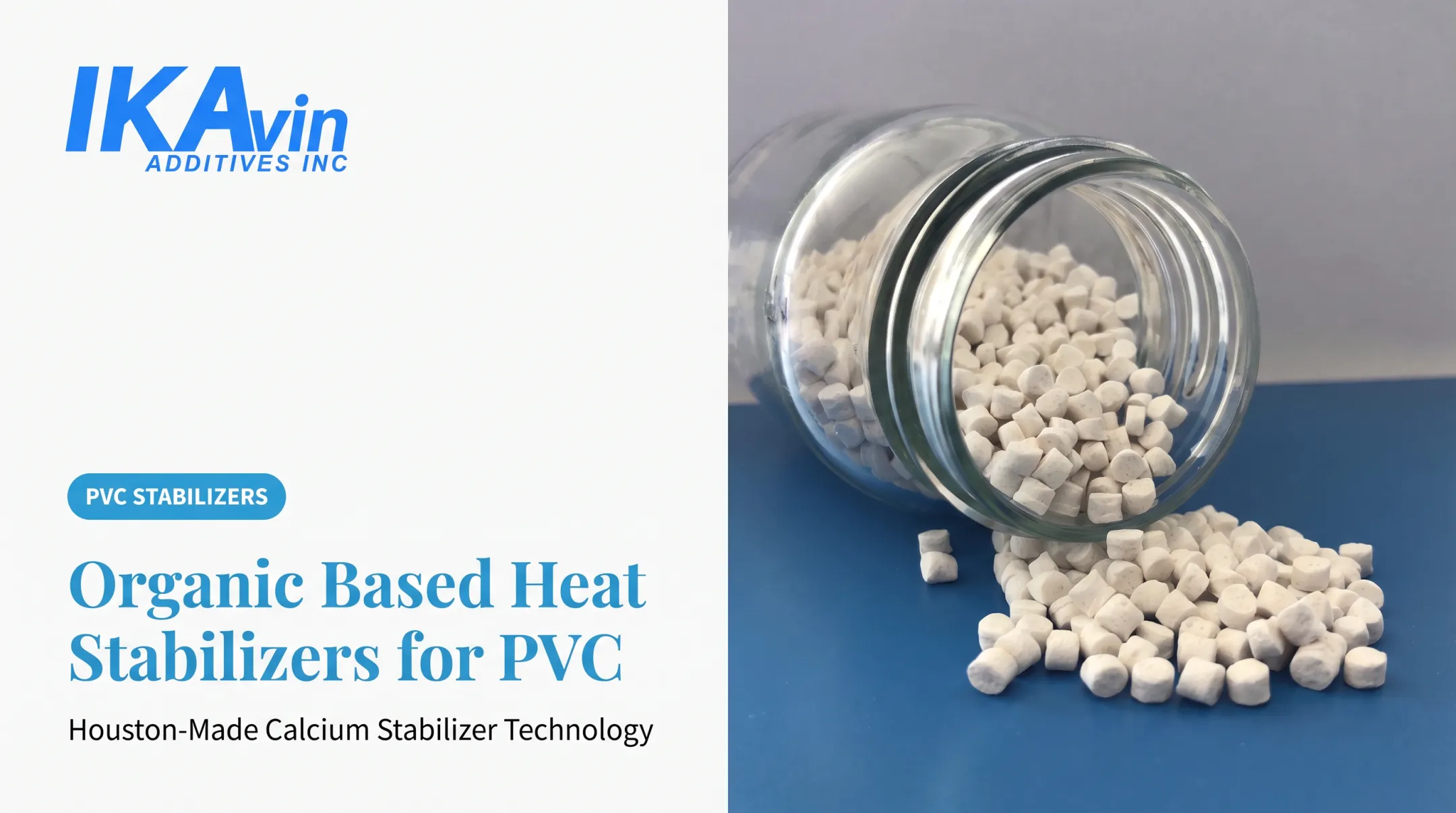
Calcium-based and Ca-Zn stabilizer systems are a common choice for more sustainable PVC production. They're available in powder, granule, pellet, and flake forms, and they support a wide range of applications:
- Wire and cable insulation/jacketing
- Window and technical profiles, including foamed profiles
- Pressure, sewer, corrugated, and drainage pipe; cable ducts
- Rigid calendering films
- Select flexible applications
Before committing to a Ca-Zn system, validate these attributes under your processing conditions:
- Color hold and early color
- Fusion behavior and lubrication balance
- Weatherability
- Long-term thermal stability
Organic Co-Stabilizers and Calcium-Organic Systems
Metal soaps rarely work alone. Most calcium-based packages lean on organic co-stabilizers to round out performance:
- Epoxidized soybean oil adds HCl scavenging and helps with color hold, especially in flexible formulations
- Beta-diketones improve early color and whiteness
- Polyols and phosphites support long-term stability and help control late-stage darkening
- Hydrotalcite-type co-stabilizers add HCl-scavenging capacity in rigid compounds
Calcium-organic systems push this approach further, using organic stabilizing chemistry alongside calcium to reduce reliance on zinc. The right balance depends on the product, the process, and the color target, so co-stabilizer choice should be validated as part of the complete package rather than treated as an afterthought.
Barium-Containing and Mixed-Metal Systems
Liquid mixed-metal systems built on Ba-Zn, Ca-Zn, or Mg-Zn carboxylates typically appear in flexible PVC. They usually need co-stabilizers, antioxidants, and phosphites to hit target performance.
Common uses include:
- Calendered films and coated fabrics
- Hoses and injection-molded footwear
- Plastisols for flooring and wall coverings
Exact performance still depends on the complete stabilizer package, not any single component.

What Is a One-Pack PVC Stabilizer?
A one-pack is a pre-blended stabilizer package designed to simplify dosing. Instead of separately weighing multiple additive components at the production line, processors add a single, consistent package.
Practical benefits include:
- Easier inventory management (fewer SKUs to track)
- Fewer weighing and metering steps, reducing operator error
- More consistent additive distribution batch to batch
- Support for cleaner, more repeatable production workflows
A one-pack isn't automatically the right answer, though. It still needs to be evaluated against your resin, plasticizer, filler, pigment, lubricant, processing equipment, and end-use requirements before you commit.
How to Choose a PVC Heat Stabilizer
Choosing a stabilizer starts with the product, not the additive catalog.
Start With the Product and Process
First, identify whether you're working with rigid or flexible PVC, and whether the process is extrusion, injection molding, calendering, blow molding, or compounding.
Each combination carries different residence time, shear, throughput, and melt temperature profiles. Those variables directly shape the stabilization package you need.
Match Stabilizer to Finished-Product Properties
Different end products demand materially different stabilizer designs:
| Application | Key Property Priorities |
|---|---|
| Pipe & conduit | Long-term thermal stability, color control, dimensional accuracy |
| Window profiles | Surface finish, weatherability, weld strength |
| Wire & cable | Electrical performance, heat-aging resistance |
| Flooring | Color retention, clarity, processing consistency |
| Foam board | Foam-cell structure, density control |
A stabilizer optimized for pipe extrusion won't necessarily perform well in a foamed profile line, even if both are technically "rigid PVC."
Check Compatibility With the Rest of the Formulation
Stabilizers don't work in isolation. They interact with plasticizers, fillers, pigments, impact modifiers, processing aids, lubricants, blowing agents, and any recycled content in the mix. Getting this balance wrong creates real problems:
- Under-stabilization leads to premature discoloration and degradation
- Over-stabilization can waste additive cost without adding benefit
- Poor fusion or excessive lubrication shows up as surface defects
- Plate-out fouls equipment and disrupts continuous runs
Build a Real Validation Plan
Run controlled trials comparing the candidate stabilizer against your current formulation on:
- Processing stability and torque/melt behavior under your normal run rates
- Color change after controlled heat exposure
- Surface quality and plate-out tendency on longer runs
- Mechanical properties against your current spec limits
- Heat-aging performance over the timeframe your application requires

Dosage and test conditions should come from supplier technical data sheets and your own process validation work, not generic online recommendations that ignore your specific equipment and formulation.
Don't Skip Specification and Sustainability Review
Check customer specifications, end-use performance targets, and product-contact considerations where relevant (drinking water components, for instance, are typically tested to their own health-effects standard). Ask suppliers for safety data sheets and technical data sheets as standard documentation.
One more thing: "sustainable" needs backing. A specific formulation detail, sourcing practice, or lifecycle data point means something. The word alone doesn't.
Apply that same standard when you shortlist suppliers. IKAvin Additives Inc. manufactures calcium-based stabilizer one-packs and custom formulations for flexible and rigid PVC, supported by technical assistance and quality testing. Rather than offering one universal product, IKAvin works through the resin, process, application, and target performance with each customer before recommending a specific package.
PVC Heat Stabilizer Applications
Different PVC products face different performance challenges, and the stabilizer package needs to reflect that.
Rigid Pipes, Conduit, and Fittings
These applications run long, continuous extrusion cycles where thermal stability and color control over extended residence time matter most. Matched one-packs include:
- IKAstab HGS 2000: Conduit extrusion
- HGS 2700: Pressure and drainage pipe
Windows, Profiles, Siding, and Foam Board
Outdoor-facing profiles add weatherability, surface finish, and welding performance to the priority list. Foam board and sheet also need consistent cell structure.
- IKAstab HGS 5300: Window profiles
- HGS 5100: Technical profiles
- HGS 6100/8100: Rigid foam profiles, sheets, and boards
- IKAvin HGS 1000: Siding and fence substrate
Wire, Cable, Hose, Flooring, and Molded Goods
Flexible PVC shifts the priorities toward electrical performance, color hold, and consistent processing across many small-volume grades.
- Wire & cable: HGS 5200 (sheathing/jacket), HGS 4100 (insulation), HGS 3400 (specialty wire and cable)
- Flooring: HGS 9400 (resilient flooring), HGS 9900 (cushioned vinyl)
- General-purpose flexible: Custom one-packs for hose, tube, and molded parts
Quick Troubleshooting
Early yellowing or darkening? This often points to a heat-stability gap or extended residence time, but check equipment condition, contamination, shear levels, and pigment interactions before assuming the stabilizer alone is at fault.
Poor surface finish or plate-out? This usually reflects formulation balance or processing conditions rather than stabilizer dosage alone. Run controlled tests before adjusting dosage levels blindly.

Conclusion
PVC heat stabilizers are practical formulation tools. They protect processability and help preserve appearance, durability, and performance in the finished product, whether that's pipe, window profile, cable jacketing, or flooring.
Getting the selection right means working through these factors in order:
- PVC type
- Processing method
- Required properties
- Formulation compatibility
- End-use and product-contact requirements
- Sustainability goals
- Validated production trials
If you're manufacturing PVC products in the U.S. or North America and want to talk through calcium-based one-packs or a custom stabilizer solution, contact IKAvin Additives Inc. for a technical discussion specific to your resin, process, and application.
Frequently Asked Questions
What is a PVC stabilizer and what is it used for?
A PVC stabilizer is an additive system that protects PVC from thermal degradation during processing and service. It reduces discoloration, HCl release, and mechanical property loss caused by heat and shear.
What are the best heat stabilizers for PVC?
There's no single "best" stabilizer. The right choice depends on PVC type, processing method, performance requirements, end-use conditions, and the complete formulation being used.
What is a one-pack PVC stabilizer?
A one-pack is a pre-blended stabilizer package combining multiple additive components into one product. It simplifies dosing, improves handling, and supports more consistent formulation control.
What temperatures can PVC withstand?
Processing temperature and long-term service temperature are different things. Processing typically occurs well above service limits, so always rely on the specific PVC grade, exposure conditions, and supplier data rather than a general number.
What are the types of PVC?
PVC is generally split into rigid (PVC-U) and flexible/plasticized (PVC-P) types. Each type has different stabilizer and additive needs based on its intended flexibility, processing method, and end-use performance.