
Introduction
Plastics sustainability isn't just about the resin. The additives you blend into that resin shape processing efficiency, durability, recyclability, and the material's overall environmental footprint just as much.
Many processors struggle with a specific tension: how do you meet sustainability goals without sacrificing thermal stability, color consistency, surface quality, mechanical performance, or line efficiency? Swap one additive for a "greener" option, and you risk destabilizing an entire production line.
This guide breaks down what green polymer additives actually are, how they function inside plastics like PVC, and how to evaluate sustainability claims with real evidence instead of marketing language. We'll also cover practical questions to ask suppliers before you commit to a formulation change.
Key Takeaways
- Renewable or bio-based content is not automatically biodegradable or environmentally preferable.
- Judge additives on performance, compatibility, sourcing, safety data, and end-of-life behavior—not claims alone.
- Calcium-based stabilizer one packs plus application-specific support help PVC processors balance reliability and sustainability.
- Validate sustainability claims with technical data sheets, testing, and direct supplier conversations.
What Are Green Polymer Additives?
A polymer additive is any substance blended into a resin to improve processing, stability, appearance, durability, or another targeted property. Additives aren't the base plastic. They're the supporting chemistry that makes the resin usable, consistent, and fit for purpose.
"Green" can describe several different things, and that's where confusion starts. Depending on context, it might refer to:
- Renewable or bio-based feedstocks
- Calcium-based stabilizer chemistries
- Safer, lower-hazard ingredient choices
- Improved manufacturing efficiency (less scrap, lower energy use)
- Support for recycling or extended product lifespan
Why Terminology Precision Matters
Treating "bio-based," "biodegradable," "compostable," and "recyclable" as interchangeable is a common and costly mistake if you're making public claims. Bio-based simply means part of the material's carbon came from renewable sources. It says nothing about whether that material breaks down in the environment.
ASTM D6866 measures biobased carbon content through radiocarbon analysis, but the standard explicitly does not establish biodegradability, compostability, or environmental impact. A stabilizer could be 100% bio-based and still persist indefinitely in a landfill.
This distinction isn't academic. A buyer who reads "bio-based" as "biodegradable" can end up routing product into the wrong waste stream or repeating an unsupported claim to their own customers. Any public environmental claim should be specific, clearly qualified, and backed by evidence for the finished product and its typical disposal route.
An additive also can't be judged in isolation. Renewable sourcing doesn't guarantee compatibility with your resin, freedom from migration issues, or a smooth end-of-life path. Every additive needs assessment within the complete formulation and product lifecycle, not just at the ingredient level.
How Green Polymer Additives Work in Plastics
Additives serve distinct functional roles, and understanding these roles is the first step toward evaluating whether a "greener" option will actually work in your application.
Core functional roles include:
- Stabilizing polymers against heat and oxidation
- Improving lubrication and mold release
- Modifying flexibility
- Controlling surface properties
- Improving pigment or filler dispersion
- Supporting overall processing consistency
Thermal Stability in PVC Processing
PVC is particularly sensitive to heat. During extrusion or molding, PVC typically softens around 170-180°C, and without adequate protection, it degrades through dehydrochlorination, releasing hydrogen chloride and forming polyene sequences that cause discoloration and mechanical breakdown.
Stabilizers interrupt this degradation pathway. Both rigid and flexible PVC formulations depend on thermal protection during processing and, often, continued protection against UV and weathering during service life.
A 2026 review in the Journal of Vinyl and Additive Technology describes how modern calcium-zinc stabilizer packages, supported by organic co-stabilizers like epoxides and polyols, have become a mainstream route to reliable heat stabilization in both rigid and flexible PVC.

Compatibility, Migration, and Dosage
An additive's performance depends on how well it distributes and stays put within the polymer matrix. Polarity, processing temperature, resin type, and the presence of plasticizers all affect how an additive behaves, and whether it migrates out over time.
Dosage is formulation-specific, not universal:
- Too little additive fails to provide adequate thermal or mechanical protection
- Too much can raise costs, affect surface finish, alter mechanical properties, or create compatibility issues with other ingredients
This is where a calcium-based one-pack approach earns its place in many formulations. IKAvin's calcium-based stabilizer one-packs, for example, combine coordinated components designed for specific PVC applications.
Suitability still depends on your exact formulation, processing conditions, and validation testing. No stabilizer works identically across every line.
Types and Applications of Sustainable Polymer Additives
Each additive category solves a different processing or end-use problem—and the sustainability lever changes with it.
| Additive Category | Primary Function | Sustainability Angle |
|---|---|---|
| Stabilizers | Prevent thermal/UV degradation | Calcium-based chemistries, less scrap, longer service life |
| Lubricants & processing aids | Reduce friction, improve flow | Processing efficiency, reduced scrap |
| Plasticizers | Increase flexibility | Renewable feedstock options, migration behavior |
| Impact modifiers | Improve toughness | Extended product lifespan |
| Flame retardants | Reduce ignition/spread | Lower-hazard chemistries |
| Antistatic/antifogging agents | Surface property control | Application-specific efficiency gains |
Matching Additives to PVC Applications
Sustainability priorities shift depending on the end product:
- Pipe, conduit, and fittings – thermal stability and long-term pressure performance
- Windows and technical profiles – weatherability, color hold, and welding performance
- Siding, fencing, trim, and foam board – foam cell structure and dimensional stability
- Wire and cable – electrical properties and heat-aging resistance
- Flooring – color consistency through calendering and lamination
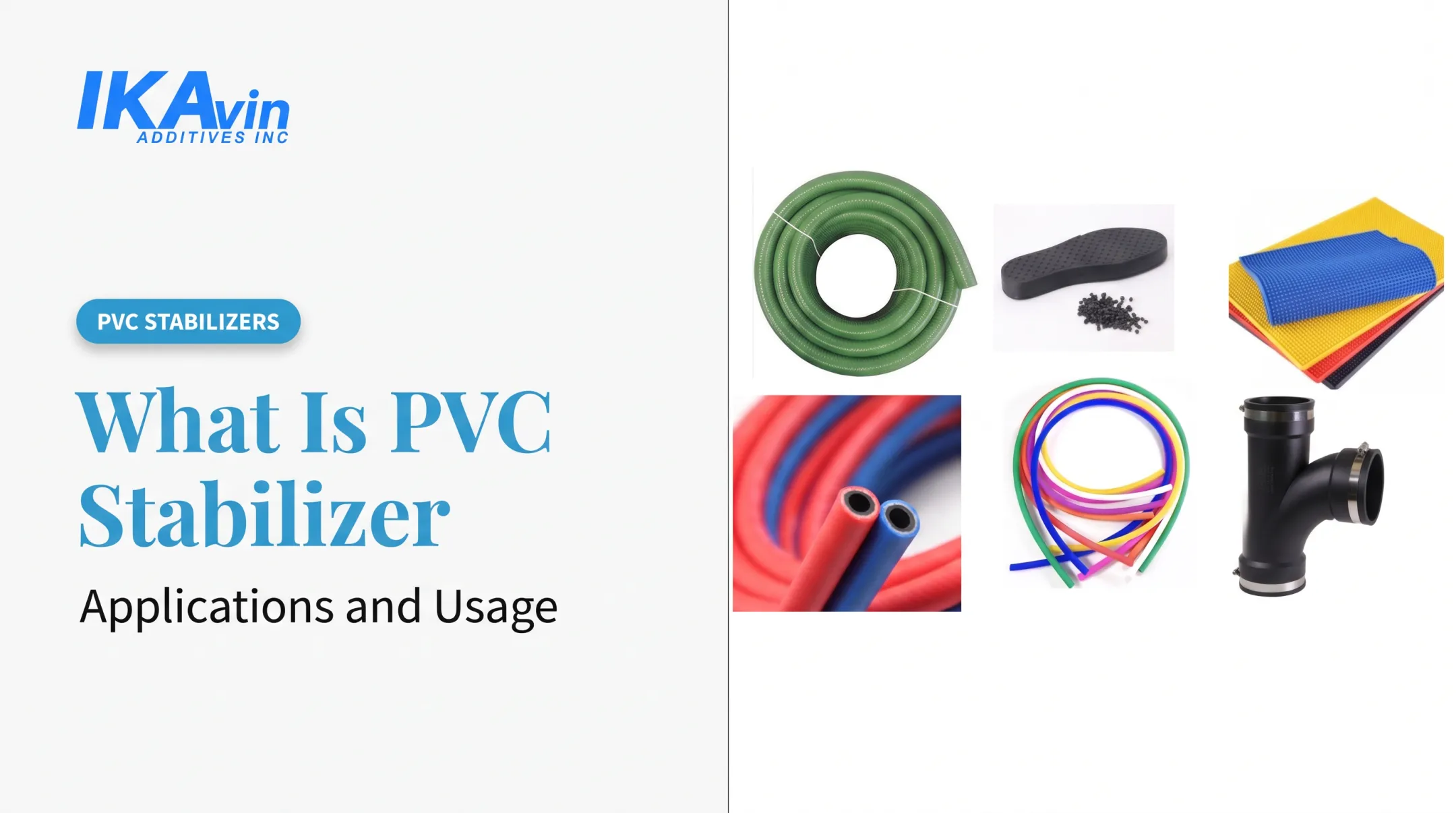
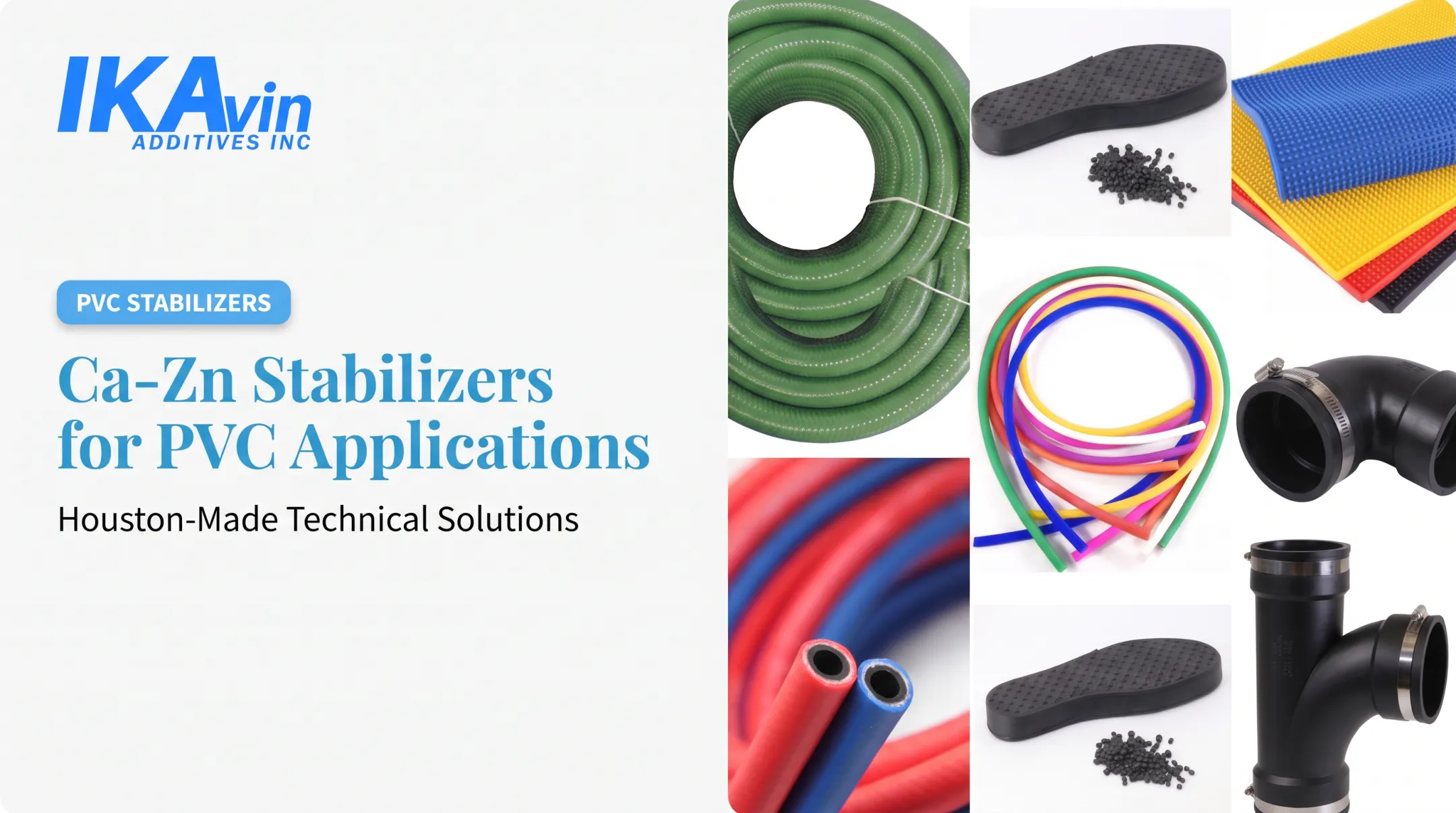
- Hose, tubing, and molded goods – clarity, softness, and stable heat performance across small-volume grades
IKAvin maps calcium-based stabilizer one-packs to those same PVC uses:
- Pipe and conduit – HGS 2000 (conduit), HGS 2700 (pipe)
- Windows and technical profiles – HGS 5300, HGS 5100
- Resilient and cushioned vinyl flooring – HGS 9400, HGS 9900
- Wire sheathing, insulation, and specialty cable – HGS 5200, HGS 4100, HGS 3400
Caution: Do not move an additive from one polymer or application to another without checking formulation compatibility, processing temperature limits, and end-use requirements. A package that works in flexible tubing will not necessarily hold up in rigid pipe.
How to Evaluate the Sustainability of a Polymer Additive
Marketing copy and verifiable evidence are not the same thing. A practical evaluation framework should cover:
- Feedstock origin and manufacturing process
- Energy and emissions data
- Transportation footprint
- Hazard and safety data profile
- Product durability and recyclability
- End-of-life behavior
Request Documentation, Not Just Claims
Before accepting a sustainability claim, ask for:
- Technical data sheets
- Safety data sheets
- Independent test reports
- Composition information
- Recycled-content compatibility data
- Lifecycle or third-party verification documentation
If a supplier can't produce these, the claim isn't substantiated. It's a talking point.
Durability Counts Toward Sustainability
An additive that reduces scrap, improves output consistency, or extends service life contributes to sustainability even without a renewable feedstock story. Preventing premature product failure keeps material out of landfills longer than any bio-based label alone would.

Watch for Trade-Offs
Switching additives can introduce new problems:
- Migration issues that weren't present before
- Additive depletion over the product's service life
- Recycling stream contamination
- Changes to mechanical properties
- Processing instability during the transition
Before making any sustainability claim, run comparative testing. Build a checklist that covers:
- Baseline resin data
- Processing conditions
- Target properties
- Test methods
- Clear acceptance criteria
Sensitive end uses such as food contact or potable water add another layer: generic suitability claims aren't enough, and the finished formulation should be tested for that specific use before any switch goes ahead.
How to Choose and Implement Green Additives for PVC
Start with the application and process, not the additive. Ask yourself:
- What's the processing route: extrusion, injection molding, or calendering?
- What output rate and thermal history does the line require?
- What surface finish, weatherability, flexibility, or dimensional stability does the end product demand?
One-Pack Systems vs. Separately Dosed Additives
One-pack systems bundle stabilizer, co-stabilizer, and lubricant components into a single, pre-formulated product. Compared to dosing separately, one-packs generally offer:
- Simpler handling and metering
- More consistent formulation batch-to-batch
- Easier storage and inventory management
- Fewer compatibility variables to manage on the floor
The trade-off is less granular control, so quality-control checks should confirm the one-pack performs consistently across your specific run conditions, not just in the supplier's lab.
Supplier Qualification Checklist
Not every additive supplier offers the same level of support. Look for:
- Technical depth in your specific PVC application (pipe, profile, flooring, wire, etc.)
- Willingness to customize formulations rather than push a generic product
- Documented quality testing and traceable results
- Reliable supply and clear communication
- Post-sale troubleshooting support when a line hiccups
IKAvin Additives Inc., based in Houston, Texas, works within this model. Its calcium-based stabilizer one-packs are designed for both flexible and rigid PVC, with custom formulation and technical assistance built around specific application requirements.
Commissioning Checklist Before Full-Scale Adoption
- Define the sustainability objective – calcium-based chemistry, improved recyclability, lower processing waste, etc.
- Confirm performance and end-use requirements for your application and customers
- Run laboratory trials before touching production volume
- Move to production trials under real line conditions
- Measure both performance and waste-related outcomes, not performance alone
- Document the formulation thoroughly for future reference
- Review results against your original objective before scaling up

Skipping steps here is how processors end up with color-hold problems three months into a "sustainable" formulation switch.
Frequently Asked Questions
What is a polymer additive?
A polymer additive is a substance incorporated into a resin to modify processing, stability, appearance, flexibility, durability, or another targeted property. It works alongside the base resin rather than replacing it.
What are some examples of polymer additives?
Common examples include stabilizers, lubricants, plasticizers, processing aids, impact modifiers, flame retardants, antistatic agents, antifogging agents, and release agents. Each targets a specific performance or processing outcome.
Are polymer additives safe for humans?
Safety depends on the specific polymer, additive chemistry, exposure route, concentration, and application. Always consult product safety data sheets and supplier technical documentation rather than relying on general assumptions.
What makes a polymer additive sustainable?
Sustainability may involve renewable sourcing, safer chemistry, lower-impact production, improved processing efficiency, durability, or verified lifecycle benefits. No single attribute makes an additive sustainable by itself; the full set of factors is what counts.
How do I choose a green additive for PVC?
Start with your PVC application and processing conditions, then compare compatibility, thermal stability, safety documentation, and sustainability evidence. Request testing results and rely on supplier technical support to validate the fit before scaling up.