This guide is written for U.S. PVC manufacturers running twin screw extrusion lines, whether you're producing rigid pipe and profiles or flexible wire insulation and hose. We'll cover what stabilizers actually do, how twin screw processing conditions change their performance demands, how to select the right package by application, common troubleshooting scenarios, and how to validate a formulation before it reaches full production.
Key Takeaways
- Match stabilizer choice to resin, screw design, and product specs—not a single data sheet number.
- Lubrication balance drives fusion and torque as much as stabilizer chemistry.
- Co- and counter-rotating screws change shear and residence time, shifting stabilizer demand.
- Calcium-based one-packs support sustainable PVC production when matched to the application.
- Change one variable at a time when troubleshooting, then confirm with standardized tests.
What PVC Stabilizers Do in Twin Screw Extrusion
PVC resin releases hydrogen chloride (HCl) when exposed to heat and shear. That released HCl then accelerates further breakdown and discoloration, a self-feeding cycle. In twin screw extrusion, intensive mixing and sustained barrel heat make that cycle especially aggressive.
Heat stabilizers interrupt it by replacing unstable chlorine sites on the polymer chain and scavenging the HCl before it causes further damage, according to peer-reviewed research on PVC stabilizer mechanisms.
In calcium-zinc systems specifically, the zinc chloride that forms during stabilization can actually trigger faster degradation, sometimes called "zinc burning." Calcium stearate helps delay that reaction, and hydrotalcites act as a backup HCl scavenger.

More Than Just Heat Protection
A stabilizer package rarely works in isolation. It interacts with:
- Thermal stability — how long the compound resists degradation at processing temperature
- Initial color and color hold — both at the die and after years of service
- Fusion behavior — how evenly the resin particles consolidate into a homogeneous melt
- Lubrication balance — internal and external lubricity affecting flow and release
- Surface finish — gloss, smoothness, and freedom from streaking
- Long-term performance — mechanical and electrical properties over the product's service life
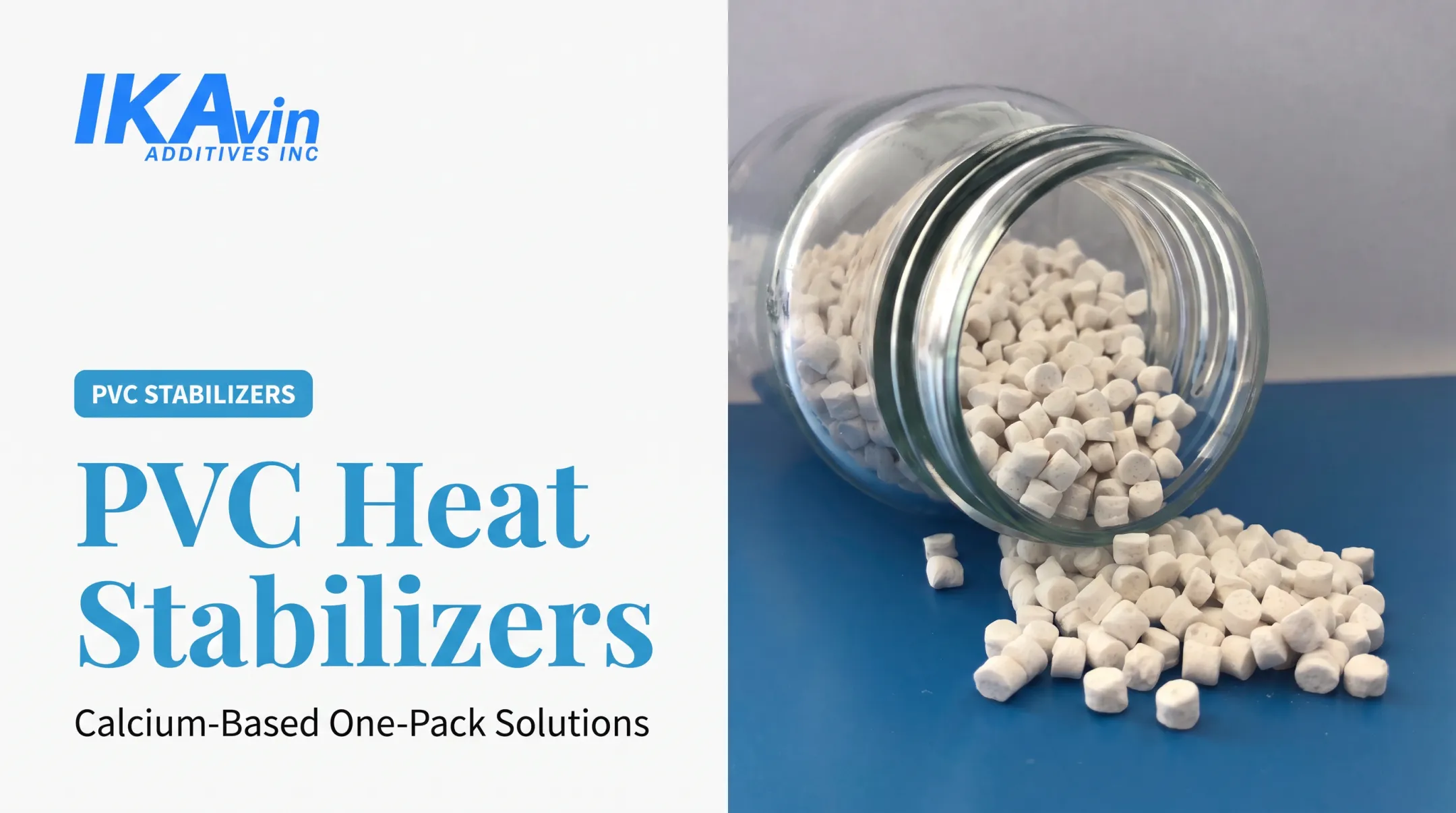
Why Calcium-Based One-Packs
Many manufacturers are shifting toward calcium-based stabilizer one-packs for more sustainable PVC production and a simpler, consolidated additive system. That's a reasonable direction, but confirm any specific environmental claim against your customers' actual requirements before building it into a customer-facing spec.
Variables That Shape the Final Package
Beyond the stabilizer itself, formulators need to account for:
- PVC resin grade and particle characteristics
- Plasticizer level (for flexible compounds)
- Fillers and pigments
- Impact modifiers and processing aids
- Lubricant type and loading
- Moisture content
- Recycled or regrind content
Get any one of these out of balance, and the stabilizer package has to compensate for problems it wasn't designed to solve.
How Twin Screw Extrusion Affects PVC Stabilizer Performance
A twin screw extruder moves PVC through several distinct stages: feeding, conveying, plasticization, mixing, venting or degassing, pressure development, and die delivery.
In co-rotating twin screw systems, these stages are typically set up as configurable zones within a modular barrel. Each stage can be tuned independently, so stabilizer performance can't be assessed in isolation from the machine it runs on.
Co-Rotating vs. Counter-Rotating Designs
The two screw architectures behave differently, and neither is universally better for PVC:
| Design | Mixing & Shear | Common PVC Fit |
|---|---|---|
| Co-rotating | Screws turn together; intermeshing drives strong material exchange and mixing | Compounding applications, including cable compounds |
| Counter-rotating | Opposing screws create a calendering-style conveying action with comparatively lower shear | Rigid applications such as pipe, profile, sheet, and foam |
Counter-rotating designs tend to limit shear-generated heat, which is one reason they show up often in rigid PVC lines. That doesn't mean counter-rotation is essential for every rigid application, or that co-rotating screws can't handle heat-sensitive PVC with the right screw configuration.
What Changes the Stabilizer's Workload
Several process variables directly affect how hard the stabilizer package has to work:
- Screw configuration and kneading section design
- Screw speed and feed rate
- Barrel temperature profile and resulting melt temperature
- Residence time and torque
- Venting efficiency
Push shear or thermal exposure too far, and you'll see yellowing, darkening, torque instability, fumes, or surface defects. Run insufficient mixing instead, and stabilizer distribution turns uneven, producing inconsistent heat stability batch to batch.
Lubrication Balance and Feeding Consistency
Lubrication and stabilization are linked, not separate systems. Too much external lubricant can delay fusion. An unsuitable lubrication balance can raise friction, drive up torque, cause sticking, or lead to die build-up and plate-out.
One-packs that combine the stabilizer with multiple powder or additive components add another variable. Controlled feeding and dispersion become critical, since uneven dosing shows up downstream as inconsistent color or heat stability.
How to Select Stabilizers for Different PVC Extrusion Applications
Start with a selection framework before you compare grades. Match the stabilizer to:
- Product type (rigid vs. flexible PVC)
- Processing temperature and expected residence time
- Color requirements and weatherability
- Surface finish and mechanical demands
- Customer specifications that apply to your market
Rigid Pipe, Conduit, and Fittings
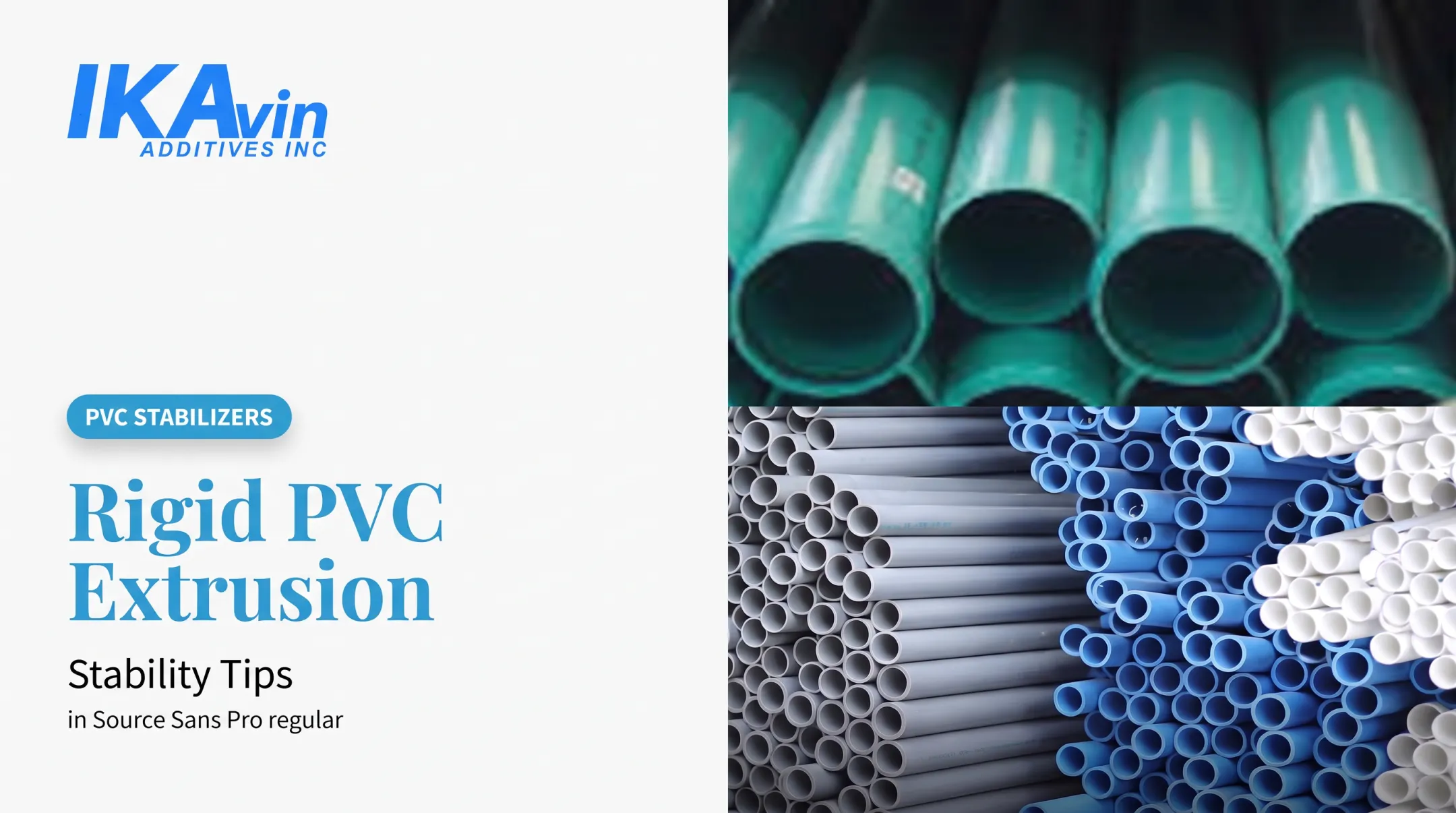
Pressure pipe, DWV pipe, and electrical conduit all demand strong thermal stability to sustain long production runs without color drift or torque instability. Fusion consistency and output rate matter just as much, since these lines typically run at high volume with tight tolerances. Check compatibility with fillers and impact modifiers as well, particularly in compounds using recycled content.
IKAvin one-packs commonly specified in this category include:
- Conduit: HGS 2000
- Pressure and drainage pipe: HGS 2700
- Injection-molded fittings: HGS 9100
Work with a technical team to confirm grade fit rather than selecting by name alone.
Windows, Technical Profiles, Siding, Fence, and Foam Board
These products live outdoors, so weatherability and color hold carry real weight. Surface appearance matters for marketability, and welding or fabrication performance affects whether the finished part holds up at the joint.
Foam-based products also need density and cell-structure control. Stabilizer-lubricant balance plays directly into how well the foam cell develops during extrusion.
Grades typically mapped to these applications:
- Window profiles: HGS 5300
- Technical profiles: HGS 5100
- Siding and fence substrate: IKAvin HGS 1000
- Rigid foam profiles, sheets, and boards: HGS 6100/8100
Wire, Cable, Hose, Tubing, and Molded Flexible Goods
Flexible compounds bring plasticizer compatibility into the equation. The stabilizer has to hold up alongside the plasticizer system without compromising flexibility retention, clarity, or color over the product's service life. Wire and cable compounds in particular carry heat-aging and electrical specifications that require validating the full compound, not the stabilizer alone.
Relevant one-packs include:
- Wire sheathing and jackets: HGS 5200
- Insulation: HGS 4100
- Specialty wire and cable: HGS 3400
- Hose, tube, and molded goods: general-purpose flexible one-packs
Flooring, LVT, and Calendered Products
Flooring runs are long and visually demanding. Color consistency across an entire run, processing stability through calendering, surface quality, and compatibility with lamination or coating layers all factor into stabilizer selection here.
IKAstab HGS 9400 is formulated for resilient flooring, and HGS 9900 addresses cushioned vinyl flooring applications.

Information Checklist Before Requesting a Stabilizer
Bring these details to a technical discussion:
- Resin and full formulation details
- Equipment type and screw configuration
- Output target and processing history
- Product specification and defect history
- Required testing and customer specifications
Troubleshooting PVC Stabilizer and Twin Screw Processing Problems
Most PVC processing problems trace back to one of a handful of root causes. Work through them systematically rather than changing several variables at once.
Yellowing or Progressive Darkening
Before reformulating, check:
- Residence time and melt temperature
- Screw speed and local hot spots
- Feed interruptions and contamination
- The compound's color history
A stabilizer that worked fine last month can look unsuitable this month if the process shifted underneath it.
Poor Fusion or Unstable Torque
Common causes include:
- Lubricant imbalance
- Insufficient or excessive shear
- Incorrect temperature profile
- Inconsistent feeding
- Resin batch variation
- Stabilizer design mismatched to the application
Die Build-Up, Plate-Out, or Surface Defects
These usually point to:
- Excessive lubrication
- Additive incompatibility
- Over-shear
- Moisture or contamination
- Poor dispersion
Run controlled trials rather than adjusting lubricants, stabilizer dosage, and temperature all in the same shift.
Inconsistent Color or Heat Stability
Check feeder calibration first, then review:
- One-pack homogeneity
- Raw-material batch variation
- Pigment interaction
- Residence-time variation
Standardized testing across batches isolates whether the problem sits with the stabilizer or somewhere else in the formulation.

Fumes, Venting Issues, or Pressure Fluctuations
These symptoms link back to:
- Degradation
- Moisture or volatiles
- Blocked vents
- Feed instability
- Process conditions outside the compound's window
Follow plant safety procedures throughout any investigation.
A Structured Trial Approach
- Establish a documented baseline for torque, temperatures, output, and appearance
- Change one major variable at a time
- Record process data at each step under steady-state conditions
- Retain labeled samples for side-by-side comparison
- Compare lab and production results against the finished-product specification
Quality checks depend on the application. Common options include:
- Color measurement (ASTM D2244)
- Heat-stability testing (ASTM D2115 or ISO 305)
- Fusion assessment via torque rheometry (ASTM D2538)
- Surface inspection and mechanical testing (ASTM D638, D256)
- Weatherability (ASTM D4329)
- Electrical testing (UL 83, UL 1581) where applicable
How IKAvin Supports PVC Stabilizer Selection
IKAvin Additives Inc. is a joint venture between Germany's IKA Group and Houston-based Ingenia Polymers, built to supply calcium-based PVC stabilizer one-packs with paired technical and manufacturing support. The company is headquartered in Houston, Texas, and supports the North American PVC market.
Selection support is built around four practical strengths:
- Calcium-based stabilizer one-packs for both rigid and flexible vinyl applications
- Custom-designed formulations rather than one-size-fits-all products
- Rigorous quality testing built into the product development process
- Technical assistance that matches the stabilizer to the twin screw process, not only the end-use label
That work usually starts with a structured review of:
- The PVC formulation in use
- Twin screw configuration and processing conditions
- Finished-product requirements
- Current production symptoms
- A validation plan before full-scale production
IKA Group brings more than 30 years of PVC stabilizer experience into that review. If your team is evaluating a calcium-based one-pack for a twin screw line, contact IKAvin’s technical group at info@ikavin.com to discuss a custom requirement.
Conclusion: Building a More Reliable PVC Extrusion Process
Stabilizer selection depends on how your PVC formulation, twin screw design, processing conditions, and finished-product requirements interact.
Key decision points:
- Identify the specific application and its performance requirements first
- Control thermal and shear history through screw configuration and process settings
- Balance stabilization with lubrication rather than treating them separately
- Monitor defects systematically instead of reacting to the most recent symptom
- Confirm performance through standardized testing before committing to full production
Working through a formulation change with a stabilizer supplier's technical team helps tighten consistency. It is also a practical way to evaluate calcium-based options without expecting a single additive package to carry every process variable on its own.
Frequently Asked Questions
How much does a twin screw extruder cost?
Cost varies widely with screw diameter, torque rating, barrel layout, controls, and downstream equipment. Stabilizer choice is a separate cost driver that shapes processing window, scrap rate, and finished-part quality.
Can you explain how a twin screw extruder works?
Material moves through feeding, conveying, melting, mixing, venting, pressure development, and die delivery. Each stage affects melt temperature and residence time, which in turn determine how hard the stabilizer has to work.
What is the difference between co-rotating and counter-rotating twin screw extruders?
Co-rotating screws turn together and create strong mixing action; counter-rotating screws oppose each other with a calendering-style, generally lower-shear conveying behavior. Neither design is universally better for PVC.
What are the key differences between single and double screw extruders?
Twin screw designs typically offer stronger, more controllable mixing and better powder handling than single screw systems. That flexibility helps complex PVC formulations—including stabilizer and lubricant packages—at the cost of added process complexity.
Why are stabilizers important in PVC extrusion?
Stabilizers protect PVC from heat-related degradation during processing, supporting consistent color, fusion, surface quality, and long-term product performance.
How do I choose a PVC stabilizer for twin screw extrusion?
Match the stabilizer to rigid or flexible PVC, then review the full formulation against screw design, temperature profile, and residence time. Confirm lubrication balance and validate color, fusion, and long-term performance in production trials.