
That's where PVC stabilizers come in. These additives protect the resin from thermal breakdown, discoloration, and loss of mechanical properties during processing and throughout the product's service life. Without the right stabilizer package, manufacturers risk yellowed pipe, brittle profiles, or cable jacketing that fails long before it should.
This guide covers what PVC stabilizers actually do, the major chemistry types available, why one-pack systems have become standard practice, and how to match a stabilizer to your specific application.
Key Takeaways
- PVC stabilizers limit heat degradation while protecting color, durability, and service life.
- Match the stabilizer to rigid vs. flexible PVC, processing method, end use, and customer specifications.
- Calcium-based systems support sustainability goals when their performance is verified per application.
- One-pack stabilizers pre-balance multiple additives, simplifying dosing and keeping formulations consistent.
What Is a PVC Stabilizer and Why Is It Needed?
A PVC stabilizer is a chemical additive, or additive system, blended into polyvinyl chloride to slow degradation caused by processing heat, oxygen exposure, and light. Without one, PVC simply can't survive the temperatures needed to extrude or mold it into a usable product.
The Degradation Problem
Here's what happens without adequate stabilization: excessive heat causes PVC molecules to release hydrogen chloride (HCl). That HCl doesn't just disappear. It accelerates further breakdown of the polymer chain, creating a chain reaction.
The trigger point is usually labile chlorine: chlorine atoms sitting at structural defects along the polymer chain, which break away more easily than the rest and start the HCl release. The consequences show up fast:
- Discoloration (often yellow, then brown or black)
- Brittleness and cracking
- Corrosion risk from released HCl
- Reduced mechanical performance
How Stabilizers Interrupt the Process
Stabilizers work through a few mechanisms simultaneously. They absorb and scavenge HCl before it can catalyze further breakdown. They also replace unstable chlorine sites on the polymer chain with more stable substitutes. In Ca-Zn systems, for example, zinc carboxylates swap labile chlorine for a more stable ester group to protect early color, while calcium carboxylates absorb the HCl and help regenerate the zinc component.

Processing stability differs from long-term stability. A stabilizer needs to get PVC through extrusion, injection molding, or calendering without breaking down. That is processing stability. It also needs to support resistance to heat, weathering, and color change once the product is in service. These are related but distinct jobs.
What Stabilizers Don't Do Alone
Stabilizers work alongside other additives, not in isolation:
- Plasticizers: control flexibility
- Lubricants: manage melt flow and reduce friction
- Impact modifiers: improve toughness
- Pigments, flame retardants, UV absorbers: handle their own separate functions
An insufficient stabilizer package shows up as early color change, plate-out on equipment, poor surface quality, inconsistent output, or brittleness. When troubleshooting, confirm whether the stabilizer is the real cause or only where the symptom shows up. Dosing errors, poor dispersion, and processing conditions can mimic stabilizer failure.
Types and Forms of PVC Stabilizers
Not every stabilizer chemistry suits every application. Manufacturers typically choose between two main families, each with distinct performance profiles.
Calcium-Based and Calcium-Zinc Systems
Calcium-based stabilizers, including Ca-Zn variants, are common in:
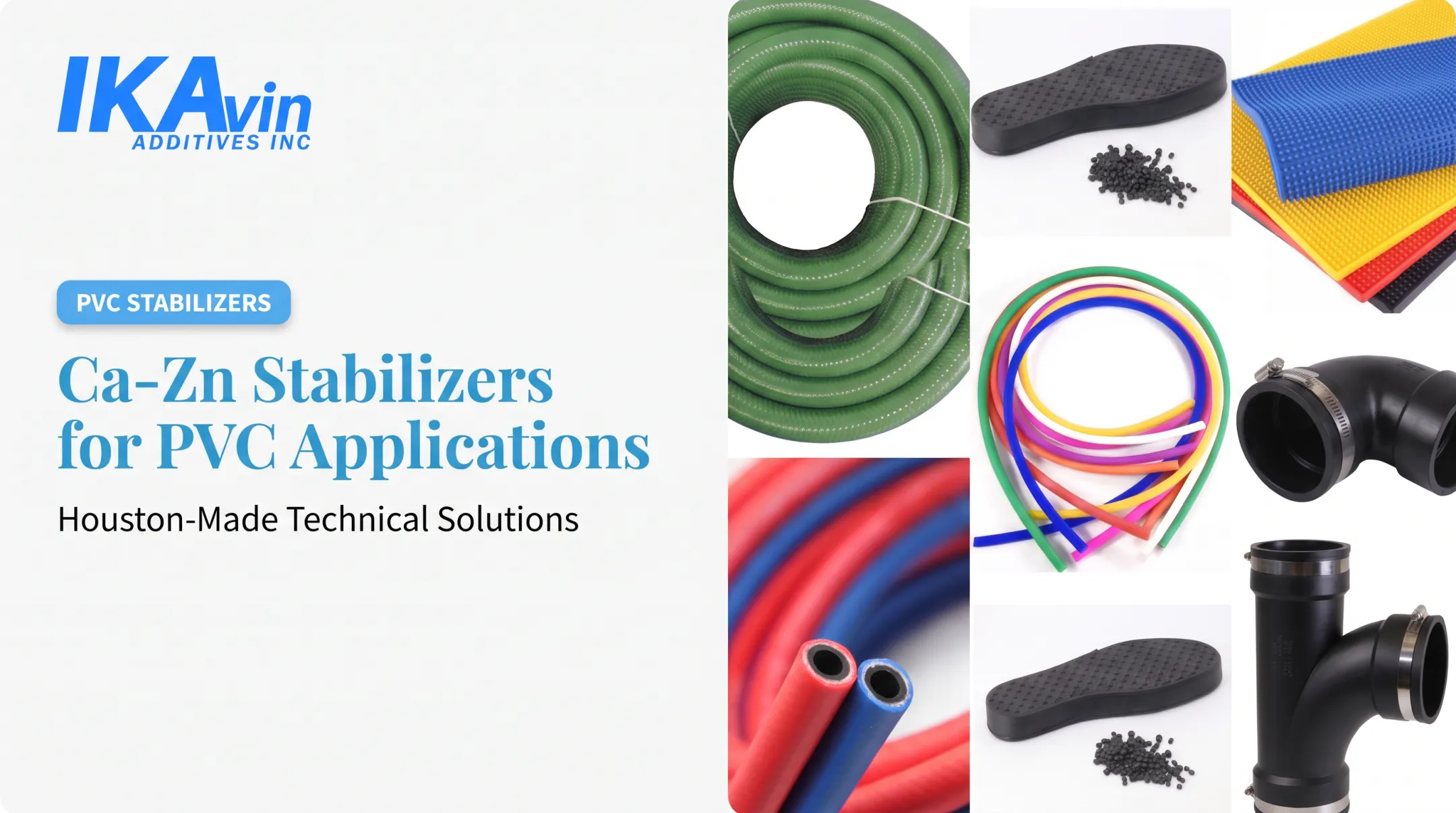
- Wire and cable compounds
- Window and technical profiles
- Foamed profiles, pipes, and fittings
- Rigid calendered films Teams often choose them when sustainability goals and formulation compatibility matter. Calcium-based one-packs typically combine the primary stabilizer with co-stabilizers and lubricants, so the same core chemistry can be tuned for rigid extrusion or flexible compounding. Color hold and weatherability still need checks against the specific formulation and end use.
Mixed-Metal Systems
Mixed-metal liquid stabilizers rely on barium, zinc, calcium, magnesium, or potassium carboxylates. Ba-Zn, Ca-Zn, and Mg-Zn systems often need co-stabilizers, antioxidants, or organophosphites to hit targets for initial color, transparency, printability, and weatherability. They are widely used in:
- Flexible and semi-rigid films
- Hoses and flooring
- Wall covering and artificial leather
- Toys
Because the right co-stabilizer balance differs between a clear film and a filled flooring compound, mixed-metal grades are usually selected by application rather than by metal pair alone.

Chemistry vs. Physical Form
Stabilizer chemistry and physical form are two separate decisions:
| Form | Typical Handling Benefit |
|---|---|
| Powder | Cost-effective, but higher dust exposure |
| Liquid | Dosage accuracy; requires tank storage |
| Granule | Feeding accuracy, low dust, good dispersion |
| Flake/Pastille | Dust-free handling, better industrial hygiene |
When comparing options, judge each system against current technical documentation—not generic chemistry rankings. Key factors include:
- Thermal stability and color retention
- Weatherability and flexibility needs
- Transparency and electrical requirements
- Sustainability goals and cost
Why One-Pack PVC Stabilizers Are Used
A one-pack PVC stabilizer is a pre-balanced blend of stabilizing components, plus any complementary additives, designed for a specific process or formulation. Instead of weighing and combining several separate ingredients on the production floor, manufacturers add one pre-formulated package.
One-pack stabilizers offer clear production advantages:
- Reduces the number of ingredients operators need to weigh and blend
- Improves dosing repeatability batch after batch
- Simplifies inventory management across multiple product lines
- Improves dispersion and color consistency
One-pack systems don't eliminate the need for good process control, though. Performance still depends on the base resin, equipment, dosage accuracy, and processing conditions working together with the stabilizer package.
Most one-packs are built around specific application categories rather than sold as one-size-fits-all products:
- Pipe and conduit — IKAstab HGS 2700 for pipe, HGS 2000 for conduit
- Window and technical profiles — HGS 5300 and HGS 5100
- Wire and cable — HGS 5200 (jacketing), HGS 4100 (insulation), HGS 3400 (specialty)
- Flooring — HGS 9400 (resilient), HGS 9900 (cushioned vinyl)
- Injection molding — HGS 9100
What to ask a supplier before switching or adopting a one-pack:
- Request the technical data sheet and recommended dosage range
- Confirm the processing window, including shear and temperature tolerances
- Check compatibility with your existing lubricants and plasticizers
- Verify storage requirements and shelf life
- Obtain safety documentation and application-relevant test results

PVC Stabilizer Applications and Usage
Rigid and flexible PVC don't need the same stabilizer treatment. Plasticizer content, processing temperature, product thickness, outdoor exposure, and end-use requirements all shift what "adequate stabilization" looks like.
Rigid PVC Applications
Rigid PVC covers pipes, conduit, fittings, window and technical profiles, siding, fencing, trim, foam board, and sheet products. These applications generally demand:
- Thermal stability through long extrusion runs
- Dimensional stability and consistent output
- Weatherability for outdoor exposure
- Strong welding performance (critical for window fabrication)
- Color hold over time
Stabilizer choice directly affects extrusion behavior: how well the material fuses, how much residence-time variation it can tolerate, and whether appearance holds steady across a multi-hour production run.
A common validation approach is to run controlled trials at target line speed, then measure color development and mechanical properties on samples pulled at intervals throughout the run, not just at startup.
IKAvin rigid-focused one-packs for this category include:
- HGS 2000/2700 for pipe and conduit
- HGS 5300/5100 for window and technical profiles
- HGS 6100/8100 for rigid foam profiles and sheets
- HGS 1000 for substrate, siding, and fence production
Flexible PVC Applications
Flexible PVC applications (wire and cable insulation, hose, tubing, flooring, sheet vinyl, artificial leather, films, and molded goods) raise a different set of priorities:
- Flexibility retention after repeated heat exposure
- Clarity (important for films and some flooring)
- Heat aging resistance
- Electrical performance for wire and cable
- Color retention despite plasticizer migration
Flexible formulations often carry plasticizers, pigments, fillers, or flame-retardant systems that interact with the stabilizer package differently than a rigid, unplasticized compound would. That is why flexible-specific one-packs are formulated separately from rigid lines:
- HGS 5200/4100/3400 for wire and cable
- HGS 9400/9900 for flooring
- HGS 7100 for films and membranes
Specialized and Performance-Sensitive Applications
Flooring, packaging, automotive interiors, and outdoor products bring tighter performance requirements for appearance, low odor, plasticizer retention, or long-term durability.
Confirm fit through application-specific testing (color hold, thermal stability, heat aging, weathering, electrical properties) rather than assuming performance from the chemical family name alone. Customer requirements vary by product category and should be confirmed directly before making any performance claim.
How to Choose and Use a PVC Stabilizer
Selecting a stabilizer starts with a clear product brief, not a chemistry preference.
Build your brief around:
- PVC type and resin grade
- Rigid or flexible structure
- Processing method (extrusion, injection molding, calendering)
- Target output and product thickness
- Required appearance and service environment
- Applicable customer specifications
From there, review the supplier's technical documentation closely:
- Recommended dosage
- Processing temperature range
- Shear and residence-time tolerances
- Compatibility with existing lubricants and plasticizers
- Storage requirements
- Batch-to-batch quality controls
A Practical Validation Sequence
- Lab screening: test candidate stabilizers against your resin and formulation at small scale
- Controlled trial runs: move to production-representative equipment
- Measure color and processing stability: track results across the run, not just at startup
- Mechanical or electrical testing: where the application demands it
- Confirm under full production conditions: final check before committing

Watch for These Usage Variables
Results can shift for reasons that have nothing to do with the stabilizer chemistry itself:
- Inaccurate weighing or dosing
- Poor dispersion in the melt
- Moisture or contamination in raw materials
- Excessive residence time in the barrel
- Incorrect lubrication balance
- Interactions with pigments or recycled content
When yellowing, black specks, brittleness, poor fusion, surface defects, die build-up, or inconsistent torque show up, check the full formulation and process setup first. Do not assume the stabilizer dosage is at fault. Changing dosage without isolating the actual cause often just masks the real problem.
IKAvin Additives Inc. works with manufacturers across rigid and flexible PVC categories on sustainable calcium-based stabilizer one-packs. Custom-designed formulations and technical assistance are matched to each application; no single product covers every process.
Why Sustainable Stabilizer Selection Matters
Manufacturers are increasingly evaluating stabilizers on more than heat performance alone. Dust-free handling, batch-to-batch consistency, dosing efficiency, and customer specifications all factor into the decision now.
Calcium-based systems support sustainability goals, but environmental preference doesn't automatically confirm technical suitability. Manufacturers still need to verify each formulation against performance targets and customer specifications for the specific application.
Beyond chemistry choice, sustainability in PVC manufacturing also comes from:
- Formulation efficiency that reduces scrap rates
- Consistent processing that limits rework
- Longer product service life
- Accurate, appropriate dosing (not over-formulating "just in case")
Those plant-level gains sit inside a larger industry push toward circularity. The Vinyl Institute reports that more than 1.1 billion pounds of vinyl materials are recycled annually across the US and Canada, including 142 million pounds of post-consumer non-packaging vinyl.
Those figures describe PVC recycling broadly, not any single stabilizer chemistry. They do show where the industry's sustainability conversation is heading.
IKAvin's calcium-based one-packs are built for that shift, but suitability still depends on verifying the specific formulation against your application's requirements. A "sustainable" label alone does not cover every technical box.
Conclusion
PVC stabilizers aren't optional extras. They allow PVC to survive processing heat while keeping its appearance, durability, and functional performance in service.
The selection principle stays the same across applications: match stabilizer chemistry and physical form to your processing conditions, performance targets, and customer requirements.
Rigid pipe does not need the same package as flexible wire insulation, and flooring does not need what window profiles need.
If you're evaluating stabilizer options for rigid or flexible PVC, IKAvin Additives Inc. supplies application-specific calcium-based one-packs with technical support. Contact info@ikavin.com or 1-832-758-6608 to discuss your formulation.
Frequently Asked Questions
What is the price of PVC stabilizer?
Price depends on stabilizer chemistry, physical form, dosage rate, application requirements, order volume, and any customization. Compare total formulation value, not just per-pound cost, because dosage efficiency drives cost per part.
What is a PVC stabilizer used for?
A PVC stabilizer reduces heat-related degradation during processing while helping maintain color, mechanical performance, and durability throughout the product's service life.
What is a one-pack PVC stabilizer?
A one-pack PVC stabilizer is a pre-balanced blend of stabilizing components, plus complementary additives where applicable, prepared for a specific PVC application or processing method.
What is PVC mainly used for?
PVC shows up in pipes, conduit, fittings, window and technical profiles, siding, flooring, wire and cable insulation, hose, tubing, films, sheets, and many other rigid and flexible products.