
Many manufacturers approach this as removing one additive and adding another at the same dosage. That approach causes real problems: color drift, reduced thermal stability, die build-up, and finished parts that fail impact or weathering requirements.
This guide is for US manufacturers of vinyl siding, trim, fence profiles, technical profiles, and foam board evaluating a calcium-based stabilizer system for performance, sustainability, customer-specification, or supply-chain reasons.
We'll cover what the conversion actually involves, which formulation and processing variables matter most, how to validate results against your existing tin-stabilized baseline, and when a full conversion isn't the right move yet.
Key Takeaways
- A calcium-based stabilizer must be evaluated across the full PVC formulation, not swapped in isolation
- Move from baseline testing through lab screening, controlled trials, pilot runs, and documented qualification
- Thermal stability, fusion, color hold, surface quality, weatherability, and output all need direct comparison with your tin baseline
- The right calcium one-pack grade and dosage depend on your specific siding or profile application, not a generic default
What Is the Conversion and Why Is It Used?
Tin-to-calcium conversion means replacing or redesigning the stabilizer portion of a PVC formulation. Instead of organotin chemistry, you bring in a calcium-based system, typically calcium-zinc or calcium-organic, while reassessing co-stabilizers, lubricants, pigments, processing aids, and related additives.
The goal is simple to state and harder to execute: maintain or improve processing stability and finished-product performance while meeting a different sustainability, compliance, sourcing, or product-positioning objective. This is a stabilization-package change, not a substrate or profile redesign, though your extrusion settings will likely need adjustment as a result.
Why manufacturers consider the switch:
- Customer specifications now call for calcium-based stabilizer systems
- Raw-material sourcing strategy favors a different supply chain
- Internal sustainability goals push away from organotin chemistry
- Supply diversification reduces dependence on a single stabilizer category
Commercial pressure is not the same as a regulatory mandate. EU REACH restrictions on organotin compounds apply to specified species, such as dibutyltin above a 0.1% tin threshold, in particular consumer articles, not organotin chemistry as a whole.
There's no documented US EPA or CPSC mandate requiring domestic siding extruders to replace tin stabilizers. For most US manufacturers, this is a business and customer-driven decision, not a compliance deadline.
Tin also hasn't disappeared from the industry baseline. A 2022 Vinyl Siding Institute environmental product declaration lists tin stabilizer at 0.6% in both of its modeled siding formulations. That's a recipe input, not a market-share statistic, but it confirms tin remains a real, active formulation choice worth preserving as a control during any trial.
What happens if you change the stabilizer and nothing else:
- Inadequate thermal protection during compounding and extrusion
- Color shift or yellowing over the production run
- Altered fusion behavior and melt characteristics
- Surface defects, plate-out, or die build-up
- Production interruptions and failed finished-profile specifications
How the Conversion Works
Conversion follows a staged path from your current tin formulation to a qualified calcium package. You characterize what you run today, screen candidates, trial them on the line, then lock in production settings.
Main inputs you're working with:
- PVC resin and K-value or resin grade
- Stabilizer package and co-stabilizers
- Lubricants, impact modifiers, and processing aids
- Pigments, fillers, and foam additives where relevant
- Existing extrusion equipment and die design
The calcium package must protect PVC from heat-related degradation during compounding and extrusion, while matching the fusion, melt flow, color, and surface quality your line already produces with tin.
Process controls that shape the result:
- Stabilizer concentration and internal/external lubricant balance
- Barrel and die temperatures, screw speed, and residence time
- Line speed, cooling, and feed consistency
Compare every trial to your tin baseline on:
- Processing window, torque behavior, and output
- Color hold, plate-out, and surface appearance
- Finished-profile dimensions
Use this sequence to keep the project controllable:
- Establish a documented baseline. Capture the tin formulation and processing settings, plus photos, color data, output, defect history, and any mechanical or weatherability results on file.
- Screen calcium candidates at lab scale. Test one or more systems, recording dosage, fusion behavior, thermal stability, color development, and lubricant compatibility. Watch for early signs of degradation.
- Run a controlled extrusion trial. Change as few variables as possible, then adjust the formulation or processing window from measured results, not a one-for-one substitution assumption.
- Confirm through pilot production. Run application-specific testing, secure customer or internal approval, and lock production documentation plus change control before full release.

Where It Is Applied and What Must Be Validated
Calcium-based conversions apply across several rigid PVC product types, and each carries its own validation emphasis:
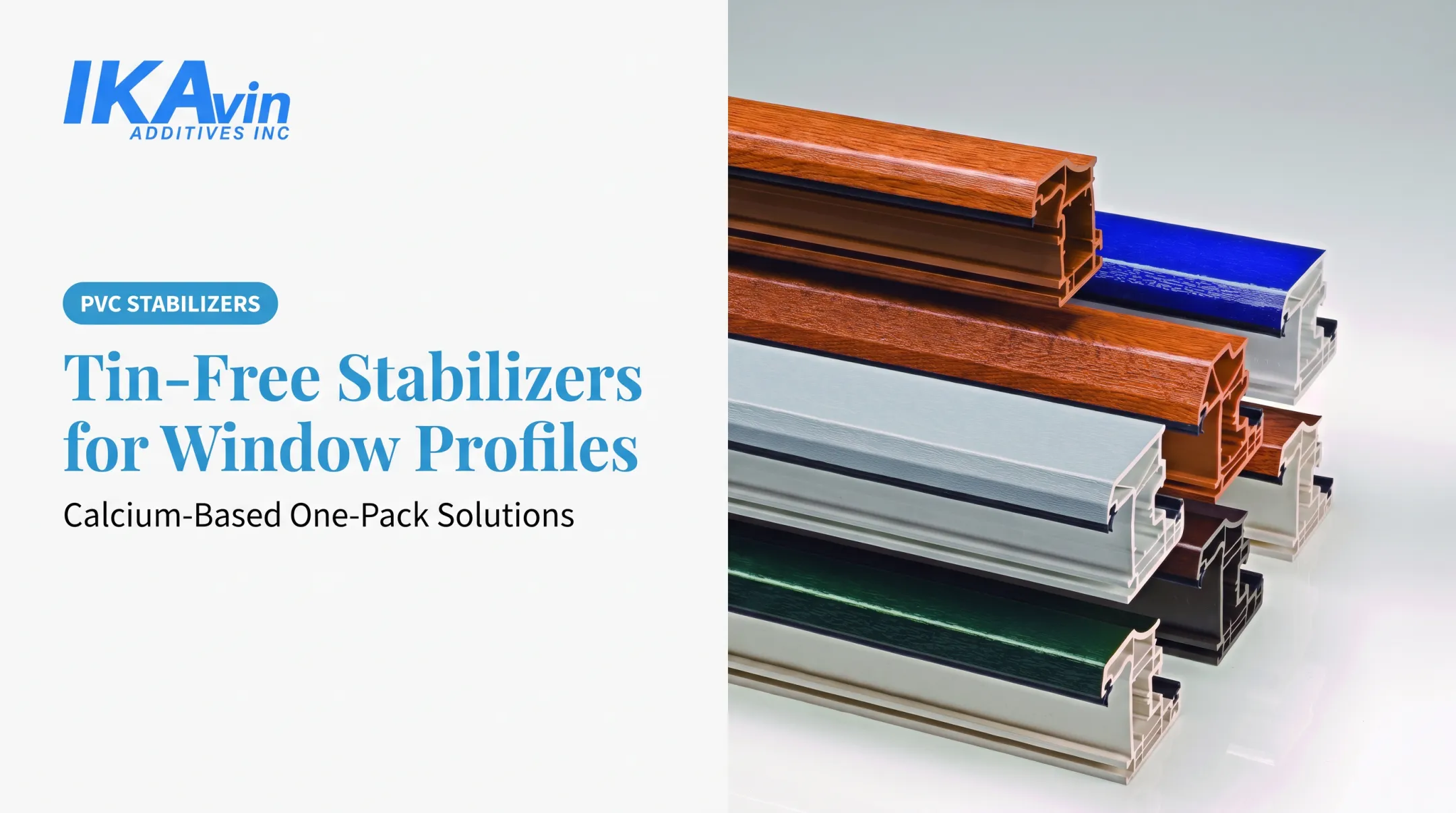
- Exterior vinyl siding (capstock and substrate)
- Trim and fence profiles
- Free-foam board and Celuka board
- Coextruded rigid PVC profiles
Solid, foamed, and coextruded products don't share identical requirements. Foam-cell structure matters for free-foam board in a way it doesn't for solid trim.
Conversion decisions typically surface during:
- Formulation development or raw-material qualification
- Customer-driven redesign or sustainability initiatives
- Supply-chain changes or legacy stabilizer replacement
Treat conversion as a one-time qualification effort, then keep monitoring quality through production. Pay closest attention when resin, pigment, filler, equipment, or supplier conditions shift.
Validation checklist:
- Thermal stability (dynamic or static heat testing as appropriate)
- Color hold and gloss/surface finish
- Fusion characteristics
- Impact performance
- Dimensional stability
- Weatherability
- Foam-cell structure for foamed products
- Relevant customer specifications
The active industry specification for finished rigid PVC siding, ASTM D3679-25, covers impact, gloss, color, weathering, and dimensional requirements for the finished product. Compound-level qualification standards address a different question, so test both the formulation and the extruded part rather than assuming one covers the other.
A calcium-based stabilizer one-pack such as IKAvin HGS 1000, built for substrate, siding, and fence production, should be selected by application and validated against your specific formulation and equipment rather than treated as an automatic drop-in.
For technical profiles, rigid foam, and sheet, grades such as IKAstab HGS 5100 and HGS 6100/8100 cover the same conversion need in those lines. IKAvin's technical team can support custom formulation work as part of a conversion program.

Before full release, run a production-readiness review that covers:
- Raw-material supply and lot-to-lot consistency
- Storage conditions and dosing accuracy
- Operator instructions and quality-control checks
- Traceability and out-of-specification handling procedures
Common Issues and When Conversion May Not Be Appropriate
The biggest misconception is that calcium-based stabilization can always replace tin at the same dosage, same lubricant balance, and identical extrusion settings. It can't. Assuming otherwise is where most conversion problems start.
Common failure modes:
- Yellowing or color drift during processing
- Reduced thermal stability or poor fusion
- Rough or dull surface appearance
- Die build-up and plate-out
- Output changes or dimensional variation
- Foam-cell instability in foamed products
- Loss of weatherability over time
Lubrication is a frequent sticking point. Calcium-zinc stabilizers can be self-lubricating, while tin stabilizers contribute little or no lubrication on their own.
That means your internal and external lubricant balance needs re-examination, not just the stabilizer dosage. A lower stabilizer purchase price doesn't guarantee a lower total-use cost once the new loading is accounted for.

A visually acceptable first extrusion run doesn't prove long-term performance. Include accelerated aging, outdoor exposure, or other application-relevant testing whenever your product specification calls for it.
Conversion may be premature when:
- Your legacy product has highly restrictive customer approvals
- Testing capacity isn't available
- Equipment instability is unresolved
- Calcium-system supply assurance is uncertain
- The candidate hasn't demonstrated a required performance characteristic
Postpone full conversion when baseline data are incomplete or a trial changes several variables at once—you won't be able to separate formulation effects from equipment or raw-material noise.
Troubleshooting path: When a trial run underperforms, separate formulation issues from processing issues before you change anything else:
- Formulation: stabilizer dosage, lubricant ratio, co-stabilizer choice
- Processing: temperature profile, residence time, feeding consistency, die design, cooling rate, measurement error
Fixing the wrong variable wastes trial time and muddies your data.
Conclusion
Converting vinyl siding from tin to calcium stabilization is a system-level PVC reformulation. It is not a single ingredient swap. A durable conversion typically requires:
- Chemistry selection matched to your compound and process window
- Extrusion optimization for stable output and surface quality
- Application-specific testing for weatherability, color hold, and durability
- Controlled production qualification before full-scale release
The goal is equivalent or better stability, appearance, processability, durability, and customer performance across the full production run.
Evidence-based trials and technical collaboration separate a conversion that holds up from one that creates months of rework. IKAvin’s calcium-based stabilizer one-packs and technical assistance can support a customized conversion program, with validation scoped to your product and customer requirements.
Frequently Asked Questions
Is tin cheaper than siding?
Tin and siding aren't directly comparable materials. Compare tin-stabilized PVC with calcium-stabilized PVC instead. Conversion economics depend on formulation cost, processing efficiency, qualification work, waste, and finished-product requirements.
Does vinyl siding need an air gap?
An air gap is primarily an installation and wall-assembly consideration, separate from the PVC formulation discussed here. Check your product documentation, building codes, and installation-system requirements for assembly-specific guidance.
Can calcium stabilizers directly replace tin stabilizers in a vinyl siding formulation?
Don't assume direct substitution will work. Dosage, co-stabilizers, lubricants, pigments, processing conditions, and performance testing may all need adjustment during conversion.
What tests are needed when converting a PVC siding formulation from tin to calcium?
At minimum, compare thermal stability, color, fusion, surface quality, dimensions, mechanical performance, and weatherability against your baseline. Add any customer or standard-specific tests that apply.
Will switching to a calcium-based stabilizer change extrusion settings?
Likely, yes. Temperature profile, screw speed, torque, residence time, line speed, lubrication, and cooling may need optimization from controlled trial data.
How long does it take to qualify a calcium-based stabilizer for vinyl siding?
Timing depends on formulation complexity, trial access, testing requirements, customer approvals, and weathering protocols. Build a staged qualification plan rather than committing to a fixed timeframe upfront.