
Without one, manufacturers see discoloration, surface defects, brittleness, and inconsistent output creep into otherwise solid formulations. Reprocessing climbs, rejected product piles up, and finished parts can fail earlier than expected in the field.
This article breaks down what a heat stabilizer actually does, why PVC specifically needs one, how different stabilizer systems work, and what to look for when choosing one for your application.
Key Takeaways
- Heat stabilizers slow PVC thermal degradation during processing and service life
- Heat drives PVC dehydrochlorination, releasing HCl that causes discoloration and property loss
- Chemistries span metallic soaps, mixed-metal systems, and organic co-stabilizers, with cost, clarity, and performance trade-offs
- Effective stabilization improves color hold, processing consistency, scrap rates, and durability
- Choose the system through application trials—not a one-size-fits-all chemistry pick
What Is a Heat Stabilizer?
A heat stabilizer is an additive, or more often a coordinated system of additives, formulated to slow the heat-driven degradation that PVC undergoes during compounding and conversion. It doesn't make PVC immune to heat. What it does is widen the usable processing window and reduce how fast and how severely degradation progresses once thermal stress begins.
That distinction matters. A well-stabilized compound can still discolor or break down if pushed far enough past its limits. The stabilizer buys margin, not immunity.
Heat stabilizers show up anywhere PVC gets heated to a processable melt:
- Extrusion for pipe, conduit, profiles, siding, and foam board
- Injection molding for fittings and molded components
- Calendering for flooring, films, and sheet products
- Flexible processing for hose, tubing, and wire insulation
How PVC Degrades Under Heat
PVC's vulnerability comes down to its chemistry. Under excessive thermal stress, the polymer undergoes dehydrochlorination, a reaction that strips off hydrogen chloride (HCl) and leaves behind chemically unstable sites along the chain.
That released HCl doesn't just disappear. It can catalyze further degradation, and the resulting conjugated double-bond sequences (polyenes) are what produce the yellow, then brown, discoloration that processors dread.
A thermal-aging study on plasticized PVC found elongation at break dropped from 276% to 258% after 10 days at 135°C, while tensile strength actually rose in that same sample. Thermal damage does not always move mechanical properties in one predictable direction (OSTI, thermal aging and ionizing radiation study).

Symptoms show up on the production floor long before anyone runs a lab test:
- Poor color hold or inconsistent shading batch to batch
- Reduced strength, brittleness, or lower elongation
- Surface streaks, specks, or roughness
- Unstable melt behavior during processing
What a Stabilizer System Does
A stabilizer package works on several fronts at once:
- Absorbs or neutralizes the HCl released during processing
- Replaces or shields unstable chlorine sites prone to further reaction
- Interrupts the degradation chain before visible color change appears
Heat stabilization is not the same as UV stabilization. Heat stabilizers address thermal stress during processing and, in some formulations, during service. UV stabilizers protect against light-driven breakdown outdoors. PVC products exposed to sunlight, like siding or fence, often need both working together.
Common Heat Stabilizer Categories
No single chemistry wins across every application. The main categories include:
- Metallic salts and metal soaps, including calcium-based systems used across pipe, profile, and cable markets
- Mixed-metal systems (such as calcium/zinc or barium/zinc) balancing cost, clarity, and performance
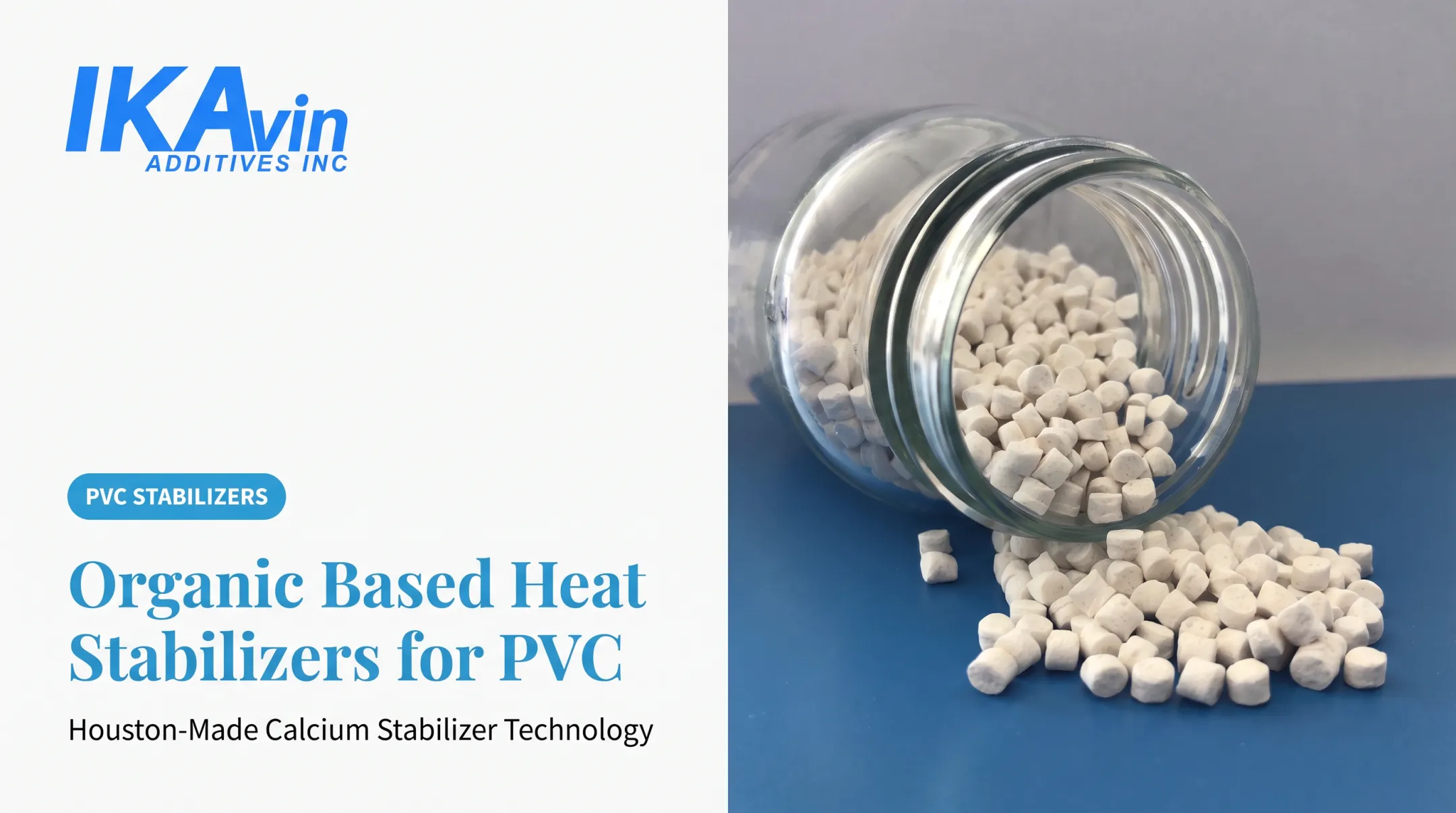
- Organic co-stabilizers, including epoxides and beta-diketones, often paired with calcium-based systems
Each comes with trade-offs in efficiency, color hold, cost, and processing fit.
Calcium/zinc systems show how these pieces work together. Zinc soaps protect early color by reacting quickly at unstable chlorine sites, calcium soaps carry the longer-term HCl scavenging load, and organic co-stabilizers help keep zinc chloride from building up and triggering sudden darkening late in a run. Getting that balance right matters more than the headline chemistry.
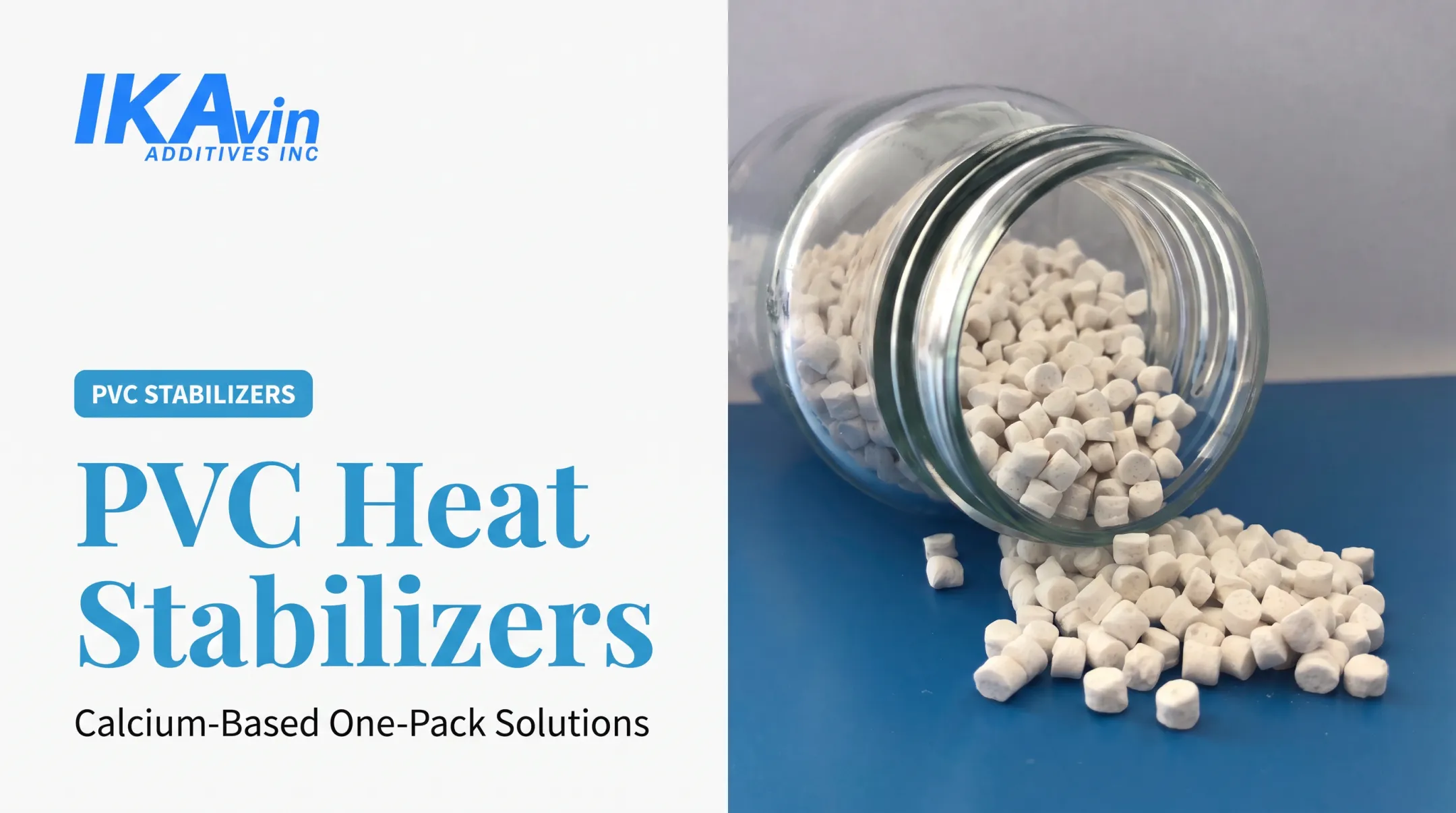
A one pack combines compatible stabilizer components, lubricants, and processing aids into a single pre-measured product. The purpose is practical: simplify dosing, reduce weighing errors, and keep batch-to-batch formulation consistent. For demanding end uses like potable water, food contact, or wire and cable, confirm that the finished compound, not just the stabilizer in isolation, has been tested to the relevant product standard (such as NSF/ANSI 61 or UL wire and cable requirements).
Key Advantages of Heat Stabilizers in PVC
The real value of stabilization shows up in operational outcomes, not just chemistry. Each advantage below ties back to quality, cost, efficiency, or product life.
Thermal Stability During Processing
A suitable stabilizer helps PVC withstand the heat and residence time involved in extrusion, injection molding, or calendering without the compound degrading mid-run. That means less sensitivity to normal temperature swings, residence-time variation, and the occasional production stop and restart.
It does not correct bad machine settings. It gives operators a wider buffer before small process variations turn into visible defects.
Why it matters:
- Fewer discoloration events across a production run
- More consistent melt behavior and torque stability
- Reduced startup losses after a shutdown
- A wider, more forgiving processing window
KPIs to watch: color variation, rejected product, startup waste, unplanned downtime, output rate, torque/pressure stability, reprocessing volume.
This advantage matters most in high-throughput extrusion, long residence times, complex profile geometries, and anywhere repeated starts and stops are routine.
Color Hold and Surface Quality
Degradation shows up visually before it shows up mechanically. Yellowing, browning, black specks, dull gloss, and surface streaks are the first signs something's off, and they're often enough on their own to get a batch rejected.
Stabilizer systems also differ in how they protect color over time. Some formulations deliver a bright, clean early color but give way quickly once their active components are consumed, while others start slightly less white yet hold off browning much longer under sustained heat.
That is why color should be tracked across the full exposure time in static oven or dynamic mill testing, not judged on a single early reading. Initial color hold and resistance to eventual browning are not the same thing.

Why it matters:
- Fewer sorted or reworked batches
- Lower aesthetic rejection on visible parts
- Reduced customer complaints tied to appearance
Pigments, lubricants, processing conditions, and contamination all play a role too, so stabilization is one variable among several.
KPIs to watch: color difference/approval rates, surface-defect frequency, first-pass yield, rework volume, batch-to-batch consistency.
This matters most for light-colored or unpigmented products, visible trim and profiles, and flooring, where consistent appearance across runs is non-negotiable.
Long-Term Performance and Reduced Waste
Limiting thermal damage during processing helps preserve the PVC article's starting properties, but service life also depends on formulation, design, weathering, UV exposure, mechanical load, and installation conditions. Stabilization is one factor in a longer chain.
Potential outcomes include better retention of flexibility or rigidity and more consistent performance over the intended service period. A vinyl siding environmental product declaration uses a 50-year reference service life as a modeling assumption, partly supported by manufacturer warranty periods; it doesn't attribute that lifetime to stabilizer performance alone.
Why it matters:
- Fewer premature failures and warranty claims
- Less material waste and fewer replacements
- Reduced environmental burden from scrapped product
A 2024 review on PVC flooring recycling notes that insufficiently stabilized material heated during recycling can shift toward a gray shade, a quality issue worth flagging for anyone managing reprocessed content.
KPIs to watch: service-failure rate, warranty claims, replacement frequency, material waste, recycled-content utilization.
This matters most for long-life products like pipe, conduit, wire and cable insulation, siding, and profiles, where premature degradation has real downstream consequences.
What Happens When a Heat Stabilizer Is Missing or Ignored
Unprotected or poorly stabilized PVC follows a fairly predictable path: excessive thermal exposure triggers dehydrochlorination, HCl accumulates, discoloration sets in, and molecular integrity breaks down. Brittleness and reduced strength follow, along with processing that gets harder to control batch over batch.
On the plant floor, that translates into:
- Inconsistent results run to run
- Higher scrap and rework volume
- Reactive troubleshooting instead of planned maintenance
- Shorter production runs before quality drifts
- Difficult color matching across batches
- Trouble scaling a formulation from pilot to full production
One caution: these same symptoms can also come from incorrect barrel temperatures, excessive residence time, poor dispersion, lubricant imbalance, contamination, moisture, or an unsuitable resin grade. Stabilization should be investigated alongside those variables, not assumed as the automatic culprit.
Controlled testing separates the two. Color checks, torque or pressure trend monitoring, visual inspection, and thermal-stability testing give you data instead of guesswork.
ASTM D2115, for example, measures relative oven heat stability through discoloration. ASTM is explicit that color alone doesn't confirm retained mechanical properties, so pairing visual checks with mechanical testing matters when the stakes are high (ASTM D2115 practice).

How to Get the Most Value from a PVC Heat Stabilizer
Stabilizer performance depends on the whole formulation and process, not on dosing more additive. Consistent application, documented trials, and regular quality review matter more than chasing the "strongest" chemistry on paper.
Match the Stabilizer to the Application
Start by evaluating:
- PVC type (rigid or flexible)
- Processing method and residence time
- Product thickness, color, and clarity requirements
- Operating temperature and outdoor exposure
- End-use requirements (food contact, potable water, wire and cable)
- Required mechanical or electrical properties
Different end uses call for different stabilizer families:
| Application | Typical priority |
|---|---|
| Pipe, conduit, fittings | Long-term thermal stability, pressure rating |
| Window and technical profiles | Surface finish, weatherability, weld strength |
| Siding, fence, trim, foam board | Foam cell structure, color consistency |
| Wire and cable | Electrical performance, heat-aging resistance |
| Flooring | Color hold through calendering and lamination |
| Flexible hose, tube, molded goods | Clarity and softness retention |
A stabilizer grade that works well in rigid pipe won't necessarily perform the same way in flexible tubing, even with the same base resin.
Validate Processing and Quality Performance
Run controlled trials comparing candidate systems under representative equipment settings, throughput, and color conditions. Check:
- Initial color and color hold after heat exposure
- Surface finish and fusion behavior
- Mechanical properties relevant to the end use
- Electrical performance where applicable
- Longer-term aging appropriate to the product's expected life
Review applicable test standards (ASTM, UL, NSF) where they actually apply to your end use. A stabilizer isn't automatically suitable just because it's marketed for a related application.
Use a Consistent, Technical Supply Partner
A pre-formulated one pack reduces weighing errors, simplifies inventory, and improves batch-to-batch dosing consistency. Validation testing is still necessary before scaling up.
IKAvin Additives Inc. supplies calcium-based stabilizer one packs for flexible and rigid PVC applications. The company offers custom-designed formulations and technical assistance for manufacturers across the North American market.
Product families cover pipe and conduit, window and technical profiles, wire and cable, vinyl flooring, foam board, and general-purpose flexible PVC. Each system is built around the processing conditions specific to that application.
Before commercializing any stabilizer system, request:
- Technical data sheets and recommended processing guidance
- Quality specifications
- Test data and certifications relevant to your end use
- Application-specific technical support
Conclusion
A heat stabilizer protects PVC from the chain of thermal reactions that can begin the moment the compound hits the melt stage. That protection helps manufacturers hold color, process consistently, and ship products that perform as designed.
The right stabilizer still comes down to application context: processing method, product geometry, end-use requirements, and long-term performance expectations—not chemistry category or price tag alone.
Treat stabilization as an ongoing quality and process-control practice, not a one-time additive decision. Back it with testing, technical guidance, and a formulation partner that can tailor the system to your product. IKAvin supports that work with custom calcium-based stabilizer one-packs and application guidance for rigid and flexible PVC.
Frequently Asked Questions
What is a heat stabilizer used for?
It protects PVC from heat-driven degradation during processing and end use, limiting discoloration and loss of mechanical properties.
What are the types of heat stabilizers?
Main categories include metal-soap systems, mixed-metal systems (such as calcium/zinc), and organic co-stabilizers such as epoxides and beta-diketones. The right choice depends on the application and processing conditions.
What is thermal stabilization?
Thermal stabilization is the use of additives and formulation controls to slow heat-induced degradation, helping PVC maintain its processing behavior and performance properties through compounding and conversion.
Why does PVC need a heat stabilizer?
PVC is particularly sensitive to thermal stress and can release HCl, discolor, and lose mechanical strength during processing without adequate stabilization built into the formulation.
How do you choose a heat stabilizer for PVC?
Match the stabilizer to your process, rigid or flexible construction, color or clarity targets, end-use requirements, weathering, and mechanical or electrical needs. Confirm the pick with application-specific trials before production.