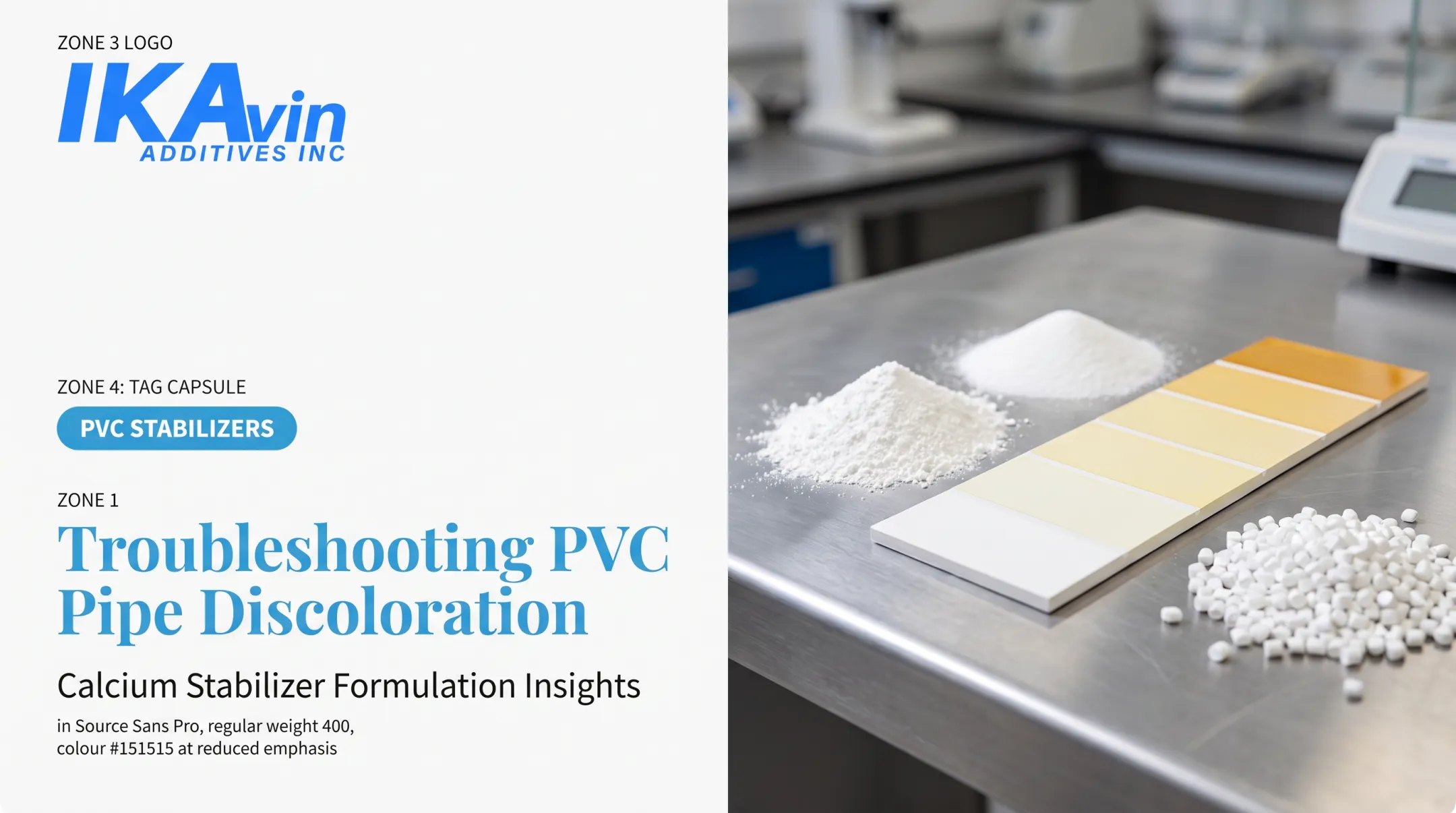
The real challenge is diagnosis. Yellowing can come from formulation gaps, heat history, UV exposure, contamination, or an additive imbalance, and each cause demands a different fix. Pinpointing the actual source cuts scrap rates, reduces customer complaints, and prevents the kind of unplanned downtime that eats into production schedules.
Key Takeaways
- Heat, oxygen, UV light, and processing stress trigger dehydrochlorination, the reaction behind PVC yellowing.
- In-process yellowing signals thermal instability, excess residence time, poor fusion, or stabilizer imbalance.
- Later yellowing often traces to weathering, oxidation, or plasticizer migration.
- Prevent it by matching formulation to application, tightening process control, and validating color stability over time.
Common Causes of PVC Yellowing
PVC yellowing falls into two categories: a surface-level color shift or a sign of deeper polymer breakdown. Yellowing that appears immediately after extrusion or molding points to processing problems. Yellowing that develops weeks or months into storage or service usually involves environmental exposure or aging.
The underlying chemistry follows the same pathway in both cases. Heat, UV radiation, oxygen, and mechanical shear can strip hydrogen chloride from the PVC backbone, a reaction known as dehydrochlorination.
This creates conjugated polyene structures, chains of alternating double bonds, that absorb light differently than intact PVC. The result is a visible shift from white or clear toward yellow, then brown, and eventually black if degradation continues unchecked, according to a 2015 photostabilization review published in the Journal of Taibah University for Science.
Formulation and Stabilizer Imbalance
Heat stabilizers exist to interrupt this degradation pathway. When they're underdosed, mismatched to the resin, or poorly distributed, PVC can discolor during extrusion, calendering, injection molding, or compounding, even under otherwise normal conditions.
Stabilizers never work alone. They function as part of a system that includes:
- Resin selection - different K-values and particle structures process differently under heat and shear
- Pigments and titanium dioxide - grade and surface treatment affect both color and long-term durability
- Lubricants - too little causes friction-driven heat buildup; too much can interfere with fusion
- Processing aids and fillers - influence melt flow, torque, and gelation behavior
- Plasticizers - type and loading affect thermal stability in flexible compounds
Changing one additive without reviewing the full package is a common reason yellowing reappears after a "fix."
Processing Conditions and Heat History
Excessive barrel or die temperature, high shear, and long residence time all push PVC closer to its degradation threshold. Unstable feeding, poor cooling, and material trapped in screw dead zones compound the risk.
A few scenarios show up repeatedly on the production floor:
- After a line stoppage - material sitting in the barrel overheats and emerges as yellow streaks once the line restarts
- During screw speed changes - color drifts if output and residence time aren't recalibrated together
- In dead zones - degraded resin accumulates and periodically sheds into the melt stream, creating intermittent discoloration
A 2001 study in Polymer Degradation and Stability re-extruded rigid PVC profiles up to five times without adding fresh stabilizer. Each additional pass increased yellow color measurably.
The researchers estimated that material extruded five times retained roughly one-third the indoor service life of material extruded once. Accumulated heat history causes real damage, not just surface staining.

UV, Oxygen, Heat, and Environmental Exposure
Sunlight, elevated service temperatures, oxygen, humidity, and even aggressive cleaning chemicals accelerate photo-oxidation over time. This is a slower process than in-process degradation, but it's just as consequential for outdoor products.
A 2024 NIST technical note examined vinyl siding under natural and accelerated weathering. It found rising infrared carbonyl signals, an increasing yellowness index with UV dose, and a shift toward brittle tensile behavior. The same study showed that a protected face and a more exposed face on the same panel discolored at different rates.
Exposure conditions vary widely by application:
| Product Type | Primary Exposure Risk |
|---|---|
| Indoor flooring, wire & cable | Heat, limited UV, chemical contact |
| Outdoor siding, profiles | Direct UV, temperature swings, moisture |
| Pipes and conduit | UV (if exposed), soil chemicals, heat |
| Flexible PVC goods | Plasticizer loss, surface oxidation |
Surface Contamination, Plasticizer Migration, and Material Aging
Not every yellow-looking part is actually degraded. Oils, smoke, dust, processing residues, and cleaning chemicals can stain a surface in ways that mimic polymer breakdown. Cleaning a sample, running comparative testing, or examining the surface under microscopy usually separates contamination from true degradation.
In flexible PVC, plasticizer migration or loss deserves specific attention. If yellowing shows up alongside stickiness, blooming, brittleness, or a loss of flexibility, the plasticizer system itself may be contributing to the problem, not just the resin.
What Happens If PVC Yellowing Is Ignored
Letting yellowing slide rarely stays a one-time issue. It tends to compound:
- Rejected batches pile up as off-color product fails quality checks
- Inconsistent appearance between production runs erodes customer confidence
- Rework and material waste increase direct costs
- Downtime grows as crews troubleshoot instead of running production
- Mechanical performance can decline alongside color—though discoloration and property loss don't always track together
That last point matters. ASTM's own guidance on oven heat stability testing (D2115) notes that PVC compositions can change color without major property loss, or hold color while other properties decline. Color alone is not a complete diagnostic.

Early Warning Signs of PVC Yellowing
Catching these early prevents a minor process drift from becoming a full batch rejection:
- Gradual loss of whiteness or brightness in finished product
- Cream or yellow coloring showing up right at the die
- Color variation across the width of a single profile
- Yellow streaks appearing right after a line stoppage
- Unexpected gloss changes
- Rising melt temperature without a corresponding setpoint change
Yellowing paired with brittleness, poor fusion, surface roughness, chalking, or an unusual odor points toward actual degradation, not surface contamination. Treat these combinations as a priority, not a cosmetic footnote.
How to Prevent PVC Yellowing
Effective prevention is a coordinated program: compound design, equipment settings, raw material control, production monitoring, and validation testing.
Formulate for the Application and Exposure Conditions
Stabilizer selection, pigment grade, lubricant balance, processing aids, fillers, plasticizers, and resin all need to match both the processing method and the expected service environment. A formulation built for indoor conduit won't necessarily hold up on an outdoor window profile.
A matched stabilizer system should be chosen the same way. IKAvin's calcium-based stabilizer one-packs are formulated by application:
- IKAstab HGS 2000 and HGS 2700 for conduit and pressure pipe
- IKAstab HGS 5300 and HGS 5100 for window profiles and technical profiles
- IKAstab HGS 9400 and HGS 9900 for resilient and cushioned vinyl flooring
- IKAstab HGS 5200, HGS 4100, and HGS 3400 for wire and cable insulation and jacketing
Matching the stabilizer package to the application supports thermal stability and color retention, but results still depend on the full formulation and processing conditions—treat product selection as a starting point for technical consultation, not a universal fix.
Control Temperature, Shear, Residence Time, and Equipment Cleanliness
Establish a validated processing window for barrel and die temperatures, screw speed, output, melt temperature, residence time, and cooling. Then check actual melt conditions, not just machine setpoints, since the two can drift apart without anyone noticing.
Build these into standard procedure:
- Purge degraded material from dead zones before it sheds into the melt stream
- Manage start-ups and stoppages with documented procedures
- Keep feeding stable to avoid surging that spikes local shear and heat
- Clean equipment thoroughly before running light-colored PVC after a dark run
Validate Raw Materials and Finished-Product Color Stability
Incoming material checks catch problems before they reach the line. Verify resin, stabilizer, pigment, filler, lubricant, and plasticizer consistency lot to lot, and measure color on finished parts for batch-to-batch comparison.
Relevant validation tests include:
- ASTM D2115 heat aging to compare oven-induced discoloration across compositions
- ASTM D2538 dynamic thermal stability and fusion testing (torque rheometer)
- ASTM E313 yellowness index for white, near-white, or colorless specimens
- ASTM G154, G155, or D2565 accelerated UV/weathering for outdoor-intended plastics
- ASTM D523 gloss measurement plus mechanical property testing
Use Controlled Trials Before Changing the Full Production Formulation
Change one significant variable at a time. Run lab or pilot trials and compare initial color, color retention under aging, processing behavior, fusion quality, and surface finish before committing to a full production run.
Keep detailed records of:
- Formulation versions and lot numbers
- Machine settings at the time of production
- Stoppages and maintenance events
- Test results tied back to specific batches
Those records let you tie a yellowing event to a specific lot, setpoint drift, or stoppage instead of starting the diagnosis from scratch.

Tips for Long-Term Prevention and Control
Sustained color consistency depends on routine discipline, not a one-time formulation fix. These practices make the biggest difference:
- Set up routine checks for color, melt temperature, torque or pressure, output, fusion behavior, and surface finish, with clear escalation criteria before off-color product moves downstream
- Train operators on approved start-up, shutdown, purge, cleaning, and troubleshooting procedures, especially to prevent overheated PVC from lingering in the machine
- Maintain documented corrective action that compares affected and unaffected batches, then reviews raw material lots and processing history to separate contamination from chemical degradation
When yellowing keeps recurring despite process adjustments, the cause is often formulation rather than operations.
IKAvin's technical team works with North American PVC processors on quality testing and custom stabilizer one-packs when standard troubleshooting falls short. Reach out through info@ikavin.com for technical input specific to your process.
Conclusion
PVC yellowing has clear, traceable causes:
- Thermal degradation
- Oxidation and UV exposure
- Contamination
- Formulation imbalance
- Gaps in processing control
Color consistency holds when formulation, production controls, validation testing, and ongoing monitoring work together. Match the stabilizer system to the end use—pipe, profile, flooring, or wire and cable—and you protect appearance, performance, and line efficiency.
IKAvin supplies calcium-based stabilizer one-packs and technical support so processors can align formulation with their process window and color-hold targets.
Frequently Asked Questions
Why does PVC turn yellow during processing?
Excessive heat, shear, or residence time can strip hydrogen chloride from the PVC backbone, a reaction called dehydrochlorination. Poor stabilization or degraded material sitting in equipment dead zones makes this worse.
Can UV exposure cause PVC to turn yellow?
Yes. UV radiation drives photo-oxidation, which produces the same color-causing structures as thermal degradation. Outdoor PVC needs stabilizers, pigments, and weathering protection matched to actual sun and weather exposure.
How do heat stabilizers help prevent PVC yellowing?
Heat stabilizers interrupt the dehydrochlorination reaction during processing, slowing the buildup of color-causing structures. They only work effectively when matched to the specific resin, additive package, and application.
Can yellowed PVC be restored?
Surface staining from contamination can often be cleaned off. Internal polymer degradation is permanent and generally requires formulation changes or part replacement rather than cleaning.
What is the difference between surface staining and PVC degradation?
Staining usually responds to appropriate cleaning and leaves mechanical properties intact. Degradation persists after cleaning and often appears alongside brittleness, chalking, or gloss loss.
How can manufacturers test PVC for color stability?
Combine yellowness index measurement (ASTM E313), heat aging (ASTM D2115), accelerated UV or weathering exposure (ASTM G154/G155), and thermal stability testing. Compare results against the specific requirements of the intended application.